Introduction: Solving the Colloquial vs. Colloquiel Confusion
In modern English orthography, simple spelling variations can cause significant confusion. A prime example is the distinction between colloquial and colloquiel. Writers and students frequently search for these terms side-by-side to understand which form is correct, why the alternative exists in search queries, and how to use the term properly in academic and creative writing.
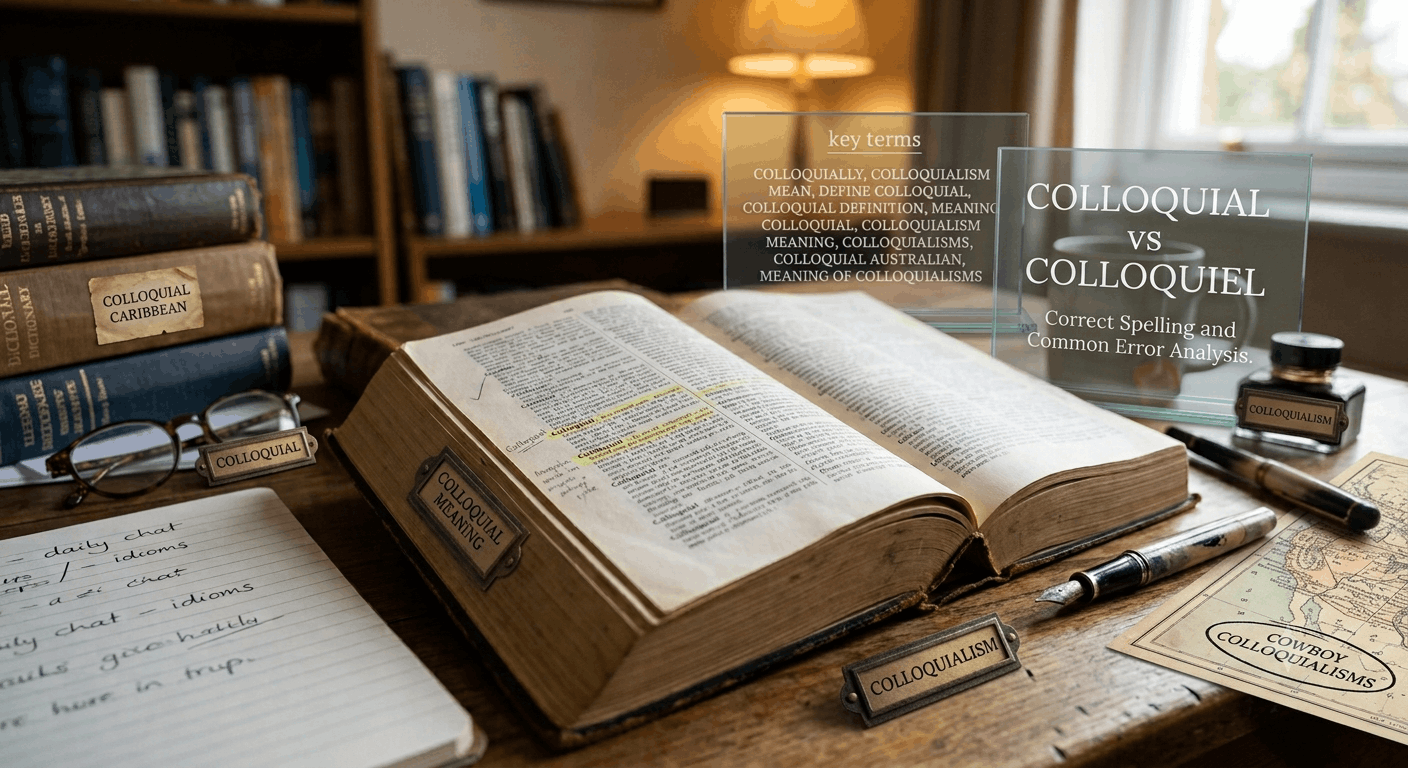
To answer directly: “Colloquial” is the only standard and grammatically correct spelling found in any recognized colloquial dictionary. On the other hand, “colloquiel” is an incorrect misspelling born from phonetic confusion and suffix misapplication.
Understanding what is colloquial language, learning how to define colloquialism, and knowing how to pronounce colloquial correctly will elevate your vocabulary and writing precision. This ultimate guide breaks down the core colloquial definition, explores colloquialisms examples across global dialects, analyzes etymology, and clarifies how to use colloquially in daily discourse.
Orthographic Comparison: Colloquial vs. Colloquiel
| Aspect | Colloquial (Correct) | Colloquiel (Incorrect) |
| Dictionary Status | Valid Standard English Adjective | Non-existent / Common Misspelling |
| Suffix Structure | -ial (Latinate adjectival suffix) |
-iel (Misapplied French-style suffix) |
| Phonetic Realization | /kəˈloʊ.kwi.əl/ |
Misspelled based on schwa sound |
| Adverb Form | Colloquially | None |
| Noun Variations | Colloquialism, Colloquiality, Colloquy | None |
Why Do People Misspell It as “Colloquiel”?
The misspelling “colloquiel” occurs due to three specific linguistic traps:
-
Phonetic Neutrality (The Schwa Vowel): When learning how to pronounce colloquial or observing the pronunciation of colloquial (
/kəˈloʊ.kwi.əl/), the final unstressed syllable produces a neutral schwa sound (/əl/). Unstressed vowels obscure spelling rules, leading writers to guess between-ialand-iel. -
French Suffix Confusion: Words imported from French often end in
-iel(such as matériel or officiel). Writers mistakenly apply this French suffix to colloquial, which actually uses the Latin-ialispathway. -
Typographical Clutter: Confusion with words ending in
-iel(like spaniel) leads to accidental letter inversion.
Etymology: Origins of Colloquial, Colloquia, and Colloquies
To understand why the -al ending is correct, we must analyze its morphological development from Latin:
Latin: con- ("together") + loqui ("to speak")
               │
               ▼
Latin: colloquium ("conversation / formal conference")
               │
               ▼
Plural Forms: colloquia / colloquies
               │
               ▼
18th Century English: colloquial (+ -al = "pertaining to conversation")
Understanding Related Root Forms
-
What is colloquia? Colloquia is the classical plural form of colloquium, referring to formal academic seminars or discussions. Colloquia definition centers on structured academic meetings where scholars present research.
-
What are colloquies? Colloquies (singular: colloquy) refers to conversations, dialogues, or conferences. The colloquies meaning encompasses both formal discussions and literary dialogues (such as the famous Erasmus colloquies from the Renaissance era).
-
Colloquiality: Colloquiality is the noun representing the quality or state of being conversational or informal in speech and diction.
Comprehensive Definitions and Core Meanings
To master colloquial/colloquialism terminology, consider these distinct dictionary definitions:
Define Colloquial (Adjective)
-
What does colloquial mean? To define colloquial (or give the definition of colloquial), it describes words, phrases, or expressions characteristic of ordinary, informal, and conversational language rather than formal speech or writing.
-
Meaning colloquial: The fundamental meaning of colloquial is “conversational.” It indicates language used naturally in relaxed daily interactions.
Define Colloquialism (Noun)
-
What is a colloquialism? If you ask what is colloquialism or what colloquialism means, it refers to a specific informal word, phrase, or idiom used in familiar conversation.
-
Colloquialism definition: The exact colloquialism definition is: “A colloquial word or phrase that is employed in conversational English rather than formal literary contexts.”
-
What do colloquialisms mean? Colloquialisms definition explains that these expressions bridge the gap between formal grammar and natural human dialogue.
Define Colloquially (Adverb)
-
Define colloquially: To colloquially define something means to describe or name it using everyday informal terms.
-
Colloquially meaning: Colloquially indicates that an expression is used informally in spoken dialogue (e.g., “The city is colloquially known as the Big Apple”).
How to Pronounce Colloquial and Colloquialism
Pronunciation varies slightly between accents, but follows consistent phonetic structures:
-
Colloquial Pronunciation / Pronunciation Colloquial:
/kəˈloʊ.kwi.əl/(kuh-LOH-kwee-ul) -
Colloquialism Pronunciation:
/kəˈloʊ.kwi.ə.lɪz.əm/(kuh-LOH-kwee-uh-liz-um) -
How to pronounce colloquialism: Focus on placing the primary stress on the second syllable (LOH).
Colloquialism vs. Slang vs. Jargon vs. Vernacular
Many speakers confuse colloquial language with slang or regional dialects.

Key Distinctions
-
Colloquial Language: Broadly understood across an entire language community regardless of subculture (e.g., “gonna”, “out of the blue”).
-
Slang: Short-lived, highly informal words tied to specific subcultures or age demographics (e.g., “no cap”, “rizz”).
-
Jargon: Specialized terminology used by professionals (e.g., medical or legal terms).
-
Vernacular: The native dialect or regional mother tongue of a specific group.
Global Examples of Colloquial Language and Colloquialisms
Examining regional colloquial words and examples reveals how informal language adapts across different cultures and geography.
British Colloquial Words & Expressions
-
Colloquial British dialogue relies heavily on understated terms.
-
Examples: “Chuffed” (pleased), “Knackered” (exhausted), “Gutted” (disappointed).
-
London Colloquialisms: Phrases like “Cockney rhyming slang” or calling a friend “mate” or “guv’nor”.
American Colloquial Terms
-
American colloquial speech blends regional idioms across vast territories.
-
Examples: “Y’all” (you all), “Buck” (dollar), “Touch base” (contact someone).
-
Philadelphia Colloquialisms: Distinct regional terms like “Jawn” (a substitute noun for any person, place, or thing) or “Hoagie” (sandwich).
-
Cowboy Colloquialisms: Historic Western expressions such as “Bite the bullet” or “Barking up the wrong tree”.
Australian & New Zealand Colloquialisms
-
Colloquial Australian / Australian Colloquial: Famous for abbreviating words and adding “-ie” or “-o”.
-
Examples: “Arvo” (afternoon), “Barbie” (barbecue), “Fair dinkum” (honest/true).
-
New Zealand Colloquial: Expressions like “Sweet as” (no problem) or “Chilly bin” (cooler).
Regional & Cultural Expressions
-
Colloquial Arabic: Regional spoken dialects (like Egyptian, Levantine, or Gulf Arabic) used in daily life as opposed to Modern Standard Arabic (MSA).
-
Cuban Colloquialisms: Caribbean Spanish terms like “¿Qué bola?” (What’s up?).
-
Colloquial Caribbean Demonym: Informal demonyms used across islands, such as “Lucian” for someone from St. Lucia or “Kittitian” for someone from St. Kitts.
Unique Word Association & Naming Examples
Colloquial language appears in domain-specific terminology, pop culture, and word games:
-
Colloquial name of the Christian symbol the ichthus: Colloquially referred to as the “Jesus Fish”.
-
Peninsula south of California colloquially: Known colloquially as “Baja” or “Baja California”.
-
Solving Wordle in five guesses colloquially: Often called hitting a “Penny” or getting it in “Five-er”.
-
“Not sketchy” colloquially: Expressed as being “legit”, “on the level”, or “above board”.
-
Drunk colloquial terms: A vast range of colloquial words examples exist for intoxication, such as “tipsy”, “sloshed”, “hammered”, or “wasted”.
-
“Not colloquially” NYT crossword context: Crossword puzzles frequently contrast formal terms with colloquially framed clues to test wordplay.
-
Colloquial implant hearing: A colloquial term often mistakenly used by the public to refer to a cochlear implant.
Synonyms and Antonyms
Synonyms of Colloquial / Colloquialism
-
Synonym for colloquialism / Synonyms of colloquialism: Informalism, vernacular term, idiom, conversational expression, parlance.
-
Another word for colloquialism / Another word for colloquial: Informal, conversational, everyday, demotic, non-formal.
-
Synonyms of colloquially / Colloquially synonym: Informally, casually, vernacularly, in common parlance.
Antonyms of Colloquial
-
Colloquial antonym: Formal, literary, academic, pedantic, official, ceremonial.
Using Colloquial Language in Sentences
Below are practical sample sentences illustrating colloquial in a sentence and sentence of colloquial applications:
-
Sentence 1 (Adjective): “Her essay was well-researched, but the professor asked her to remove the colloquial diction in favor of academic phrasing.”
-
Sentence 2 (Noun): “The phrase ‘bite the dust’ is a famous colloquialism example used in English literature and popular music.”
-
Sentence 3 (Adverb): “Although officially named the United Kingdom of Great Britain and Northern Ireland, the country is colloquially known simply as Britain.”
-
Sentence 4 (Plural Noun): “Learning regional colloquialisms helps language learners communicate naturally with native speakers.”
Stylistic Guidelines: When to Use Colloquial Diction
Understanding what is colloquial language requires knowing when its application is appropriate:
Avoid Colloquialisms In:
-
Academic dissertations and peer-reviewed journals
-
Formal legal contracts and medical documentation
-
Executive business proposals and cover letters
Adopt Colloquialisms In:
-
Fiction writing and dialogue creation (to make characters sound authentic)
-
Conversational blogging, social media content, and copywriting
-
Informal email correspondence and everyday speech
Frequently Asked Questions (FAQ)
Is “colloquiel” ever correct in British or American English?
No. Colloquiel is an unsourced misspelling in all standard dialects of English worldwide. Always use colloquial.
What is the difference between colloquial diction and slang?
Colloquial diction uses informal words widely understood by the general population in casual settings. Slang consists of ephemeral, highly specialized words restricted to specific subcultures.
How do I remember how to spell colloquial correctly?
Remember the Latin root loqui (to speak), which is also found in eloquent and lo quacious. It always ends in -ial, never -iel.
Conclusion
The debate between colloquial and colloquiel has a clear winner: colloquial is the only correct spelling recognized by standard English lexicography. Rooted in the Latin colloquium, its ending -ial reflects its role as an adjective describing everyday conversational speech. Eliminating the spelling error “colloquiel” ensures your writing remains polished, precise, and authoritative.