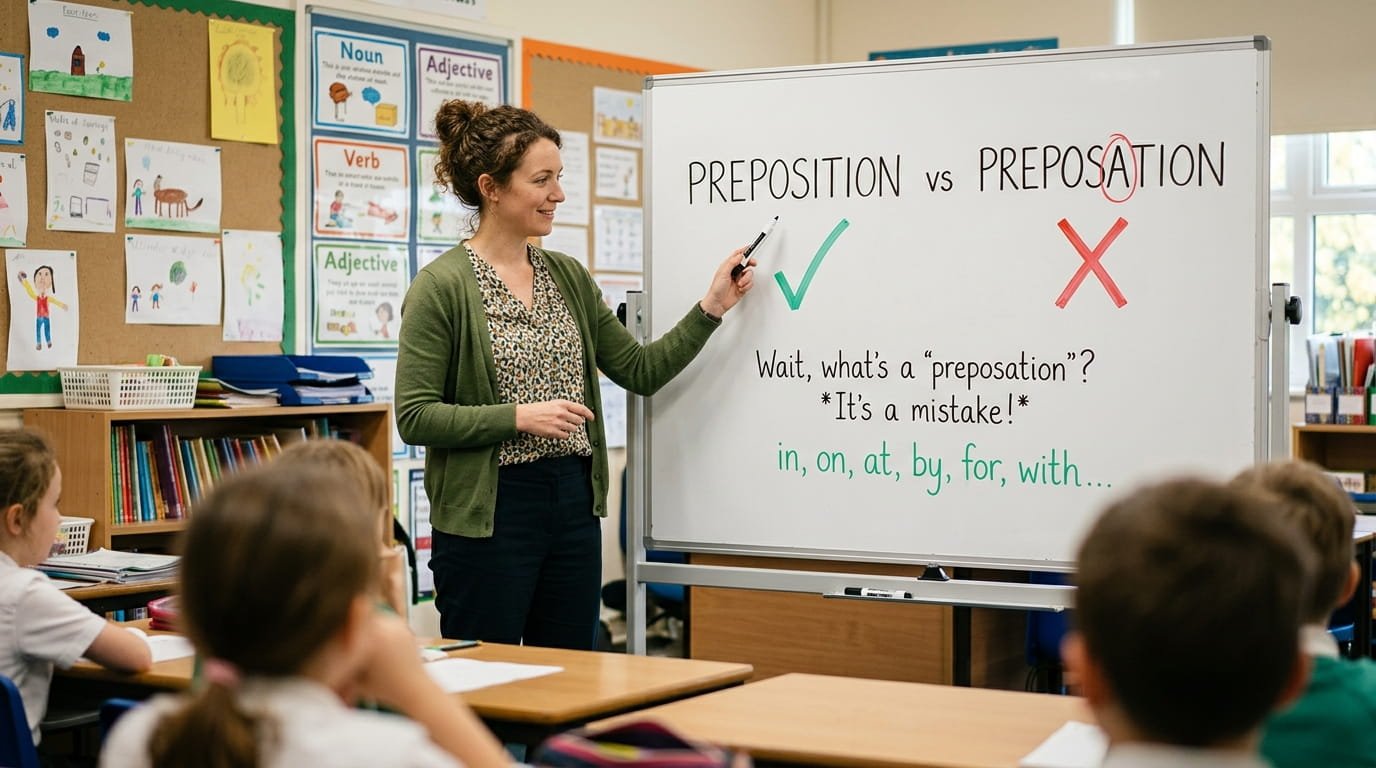
If you’ve ever typed “preposation,” “preposetion,” “praposition,” or “priposition” into a search bar, don’t worry — you’re not alone. These are simply common misspellings of one single, correct word: preposition. There is no separate grammatical term called “prepositation” or “preposetion.” All of these spellings refer to the same part of speech, and in this guide, we’ll clear up the confusion once and for all while giving you a complete, in-depth understanding of what a preposition is, how prepositional phrases work, and how to use them correctly in everyday English.
By the end of this article, you’ll know exactly what a preposition is, see a full list of prepositions, understand prepositional phrases with examples, learn the rules around ending a sentence with a preposition, and even get a quick look at how prepositions work in French and Spanish.
Quick Answer: What Is a Preposition?
A preposition is a word that shows the relationship between a noun (or pronoun) and other words in a sentence. This relationship is usually about place, time, direction, or manner. Prepositions tell us where, when, how, or in what relation something exists or happens.
Preposition meaning in simple terms: it is a “positioning” word — it literally “pre-positions” (comes before) a noun to connect it to the rest of the sentence.
Example:
- The book is on the table.
- She walked into the room.
- We will meet after lunch.
In each of these examples, the bolded word is a preposition connecting a noun (“table,” “room,” “lunch”) to the rest of the sentence, showing location or time.
Preposition vs “Prepositation” — Clearing Up the Spelling Confusion
Because “preposition” sounds a little unusual to many learners, especially non-native English speakers, it often gets misspelled in several ways:
- ❌ Preposation
- ❌ Preposetion
- ❌ Praposition
- ❌ Priposition
- ❌ Preposition preposition (a duplicate typing error)
✅ The only correct spelling is preposition.
It’s worth noting there is a related but different word: “preposing.” In linguistics, “preposing” refers to moving a word or phrase to the front of a clause for emphasis (for example, saying “Never have I seen such a thing” instead of “I have never seen such a thing”). This is different from the word “preposition,” even though the words look similar. There’s also “prepose”, the verb form, which simply means “to place before.” None of these should be confused with the grammatical term used for words like in, on, at, under, over, and between.
So whenever you’re searching for grammar help, remember: the correct word is always spelled p-r-e-p-o-s-i-t-i-o-n.
Preposition Definition (In Detail)
According to standard English grammar, the definition of preposition is:
A preposition is a word or group of words used before a noun, pronoun, or noun phrase to show its relationship to another part of the sentence — typically indicating location, direction, time, cause, manner, or possession.
Prepositions are one of the eight traditional parts of speech in English, alongside nouns, pronouns, verbs, adjectives, adverbs, conjunctions, and interjections.
Some key characteristics of prepositions:
- They almost always come before a noun or pronoun (this is why they’re called “pre-positions”).
- They cannot stand alone — they need an object to complete their meaning.
- They are usually short, high-frequency words, though some prepositions consist of more than one word (called compound or complex prepositions).
- English has a relatively fixed, limited list of prepositions compared to the seemingly endless list of nouns and verbs.
What Are Prepositions Used For?
Prepositions serve several essential grammatical functions:
1. Showing Location (Prepositions of Place)
- The cat is under the bed.
- She lives near the river.
- The keys are in the drawer.
2. Showing Time
- We’ll start at 9 AM.
- The meeting is on Monday.
- I haven’t seen him since last year.
3. Showing Direction or Movement
- He walked toward the exit.
- The plane flew over the mountains.
- She jumped into the pool.
4. Showing Manner or Method
- He solved it by trial and error.
- She spoke with confidence.
5. Showing Possession or Association
- The cover of the book.
- A friend of mine.
6. Showing Cause or Reason
- She was late because of traffic.
- He was rewarded for his effort.
Common Prepositions List
Below is a helpful list of prepositions grouped by category. This is one of the most commonly searched grammar resources, so keep this list handy as a quick reference.
Prepositions of Place
in, on, at, under, over, above, below, beside, between, among, behind, in front of, near, next to, inside, outside, through
Prepositions of Time
at, on, in, before, after, during, since, until, by, from, to, throughout
Prepositions of Direction/Movement
to, into, onto, toward, through, across, along, up, down, past, around
Prepositions of Manner
by, with, like, as
Prepositions of Agent or Instrument
by, with
Prepositions of Cause/Purpose
because of, due to, for, on account of
Common Single-Word Prepositions
about, above, across, after, against, along, among, around, at, before, behind, below, beneath, beside, between, beyond, but, by, concerning, considering, despite, down, during, except, excepting, excluding, following, for, from, in, inside, into, like, minus, near, of, off, on, onto, opposite, outside, over, past, per, plus, regarding, round, save, since, than, through, to, toward, towards, under, underneath, unlike, until, up, upon, versus, via, with, within, without
This “all prepositions” list covers the vast majority of what you’ll encounter in everyday reading and writing. While the exact number is debated (some linguists count 100+, including compound forms), the list above represents the common prepositions used in 95% of everyday English communication.
What Is a Prepositional Phrase?
A prepositional phrase is a group of words that begins with a preposition and ends with a noun, pronoun, or noun phrase (called the “object of the preposition”). Sometimes the object is modified by adjectives, which are also part of the phrase.
Prepositional phrase definition:
A prepositional phrase consists of a preposition, its object (a noun or pronoun), and any modifiers of that object.
Structure of a Prepositional Phrase
Preposition + (modifiers) + Object of the preposition
Example: “in the small, quiet garden”
- Preposition: in
- Modifiers: the small, quiet
- Object of the preposition: garden
Prepositional Phrase Examples
- She hid under the old wooden table.
- He arrived before the meeting started.
- The gift was placed on top of the shelf.
- They walked along the sandy beach at sunset.
- The letter was written by my grandmother.
- We waited for the bus in the rain.
- The cat jumped off the windowsill.
- This book is about ancient history.
Sample of a Prepositional Phrase Used in a Full Sentence
“The children played happily in the park near their house.” Here, there are actually two prepositional phrases:
- “in the park” (preposition: in; object: park)
- “near their house” (preposition: near; object: house)
Object of the Preposition — Explained
The object of a preposition is the noun, pronoun, or noun phrase that follows the preposition and completes its meaning. Every preposition needs an object to make grammatical sense; a preposition without an object is called a “particle” or is simply incomplete.
Examples showing the object of preposition:
- She is talking about the project. (object: the project)
- He gave the book to her. (object: her — note pronouns after prepositions take the object form: me, him, her, us, them, not I, he, she, we, they)
- The dog ran around the yard. (object: the yard)
This is a common point of confusion in grammar exercises (including platforms like IXL, which frequently test students on identifying prepositional phrases and their objects). The key strategy for identifying the object of the preposition is simple: find the preposition, then ask “what?” or “whom?” immediately after it — the answer is the object.
Quick tip for exercises: In a sentence like “The cat sat on the mat,” if asked to identify the prepositional phrase, the answer is “on the mat,” and if asked for the object of the preposition, the answer is simply “mat.”
Prepositions vs Other Parts of Speech: Common Confusions
A frequent question is whether certain words are prepositions or belong to another category. Let’s clarify a few of the most commonly searched examples:
- Is “for” a preposition? Yes, in most uses (“This gift is for you”), though it can also function as a conjunction (“I stayed home, for it was raining”).
- Is “with” a preposition? Yes — it shows accompaniment or means (“She came with me”; “He cut it with a knife”).
- Is “about” a preposition? Yes, when it shows topic or approximate quantity (“a book about history”; “about ten people”).
- Is “on” a preposition? Yes, typically showing position or time (“on the table”; “on Monday”).
- Is “in” a preposition? Yes, showing location or time (“in the box”; “in 2024”).
- Is “at” a preposition? Yes, used for specific points in time or place (“at noon”; “at the door”).
- Is “to” a preposition? Usually yes (“go to the store”), but “to” is also used as part of the infinitive form of a verb (“to run,” “to eat”) — in that case, it is not functioning as a preposition.
- Is “from” a preposition? Yes, showing origin (“from Paris”).
- Is “by” a preposition? Yes, showing agent, method, or proximity (“written by her”; “by the river”).
- Is “after” a preposition? Yes, when followed by a noun (“after dinner”). It can also be a conjunction (“after we ate”) or adverb.
- Is “during” a preposition? Yes — always used before a noun to indicate a time span (“during the movie”).
- Is “into” a preposition? Yes, showing movement toward the inside of something (“walked into the room”).
- Is “through” a preposition? Yes, showing movement across or within something (“through the tunnel”).
- Is “as” a preposition? Sometimes — “as” can function as a preposition meaning “in the role of” (“She works as a teacher”) or as a conjunction (“as I was saying”).
- Is “that” a preposition? No — “that” is typically a pronoun, conjunction, or determiner, never a preposition.
- Is “there” a preposition? No — “there” is an adverb of place or an expletive/dummy subject (“There is a book”), not a preposition.
- Is “when” a preposition? No — “when” is typically a conjunction or adverb.
- Is “how” a preposition? No — “how” is an adverb, not a preposition.
- Is “which” a preposition? No — “which” is a pronoun or determiner.
- Is “is” a preposition? No — “is” is a linking verb, not a preposition at all.
- Is “and” a preposition? No — “and” is a coordinating conjunction.
- Is “us” a preposition? No — “us” is an object pronoun, and it often appears after a preposition (“with us,” “for us”), but it is not itself a preposition.
The general test: if a word is followed by a noun/pronoun and shows a relationship of place, time, direction, or manner, it’s very likely functioning as a preposition in that sentence. Many English words (like “as,” “since,” “after,” “before”) can function as prepositions, conjunctions, or adverbs depending on context — so the same word isn’t always the same part of speech in every sentence.
Can You End a Sentence With a Preposition?
This is one of the most debated grammar questions in the English language, and it’s a frequently searched topic: “ending a sentence with a preposition,” “can you end a sentence with a preposition,” and “finish sentence with preposition.”
The Traditional Rule
For centuries, some grammarians insisted that a sentence should never end with a preposition, based loosely on Latin grammar rules (in Latin, prepositions cannot be separated from their objects). This led to famously awkward sentence rewrites, such as changing:
- “This is the book I was talking about.” → “This is the book about which I was talking.”
The Modern Consensus
Today, most modern grammarians and style guides agree that ending a sentence with a preposition is completely acceptable in standard English, especially in informal and conversational writing. In fact, avoiding it often makes sentences sound stiff, unnatural, or overly formal.
The famous (possibly apocryphal) quote often attributed to Winston Churchill illustrates the absurdity of rigidly avoiding this: he supposedly responded to an editor who corrected his sentence by saying something to the effect that such nonsense is “up with which I will not put” — highlighting how forcing a preposition away from the end can create clunky, unnatural phrasing.
Acceptable examples of sentences ending with a preposition:
- What are you looking for?
- Who did you go with?
- That’s the movie I was talking about.
- I don’t know where she’s from.
When to still avoid it: In highly formal writing (academic papers, legal documents, formal business letters), some writers still prefer to restructure sentences to avoid a trailing preposition, simply as a matter of style and tradition — not because it’s grammatically “incorrect.”
Prepositional Phrases: Functions in a Sentence
Prepositional phrases don’t just sit there — they play specific grammatical roles:
- Acting as an adjective (modifying a noun): “The man with the red hat is my uncle.” (describes “the man”)
- Acting as an adverb (modifying a verb): “She sang with great emotion.” (describes how she sang)
- Acting as a noun (less common): “After the game is when we’ll celebrate.” (functions as the subject)
Understanding this helps with more advanced grammar exercises, including sentence diagramming and standardized test prep, where students are frequently asked to identify prepositional phrases, determine whether they function adjectivally or adverbially, and locate the object of the preposition — a common exercise type seen on platforms like IXL and other grammar-practice tools.
Prepositions in Other Languages: A Quick Look
Since prepositions are a universal grammatical concept, it’s useful to briefly compare English prepositions with those in other widely studied languages.
Prepositions in Spanish
Common Spanish prepositions include:
- a (to, at)
- de (of, from)
- en (in, on)
- con (with)
- por and para (both roughly meaning “for,” but used in different contexts — por often relates to cause/means, para to purpose/destination)
- sin (without)
- sobre (on, about)
Spanish prepositions function similarly to English ones but often have more nuanced usage rules (especially the classic por vs. para distinction, which frequently trips up learners).
Prepositions in French
Common French prepositions include:
- à (to, at)
- de (of, from)
- dans (in)
- sur (on)
- avec (with)
- pour (for)
- sans (without)
- en (in, by, made of)
The French preposition en is particularly notable because it’s highly versatile — used for expressing “in” with feminine countries (en France), transportation methods (en voiture — by car), time duration (en une heure — in one hour), and material (en bois — made of wood).
Comparing prepositions across languages highlights an interesting linguistic truth: while nearly every language has some version of prepositions (or postpositions, which come after the noun, as in Japanese and Korean), the exact rules for which preposition to use in which context rarely translate directly from one language to another. This is why prepositions are often considered one of the hardest parts of grammar for language learners to master — English speakers learning Spanish or French, and vice versa, often make preposition errors even at advanced fluency levels.
Teaching Prepositions: The Preposition Song and Memory Tricks
Because prepositions are abstract and numerous, teachers often use creative memory tools to help students, especially younger learners, memorize them. One popular classroom tool is the “preposition song,” a rhyme or tune (sung to the melody of familiar children’s songs) that lists common prepositions in sequence — such as “about, above, across, after, against, along, among, around, at, before, behind, below, beneath, beside, between, beyond, by…” This musical repetition helps students internalize the list of prepositions in the same way the alphabet song helps with letter recognition.
Another common trick is the “anywhere a mouse can go” method: imagine a mouse and a box, and any word that describes where the mouse can go in relation to the box (in, on, under, over, beside, through, around, behind) is likely a preposition. This is a simple but effective way for beginners to grasp the preposition meaning intuitively before memorizing formal lists.
Common Grammar Exercise Questions (And How to Answer Them)
If you’re working through a grammar workbook or an online platform like IXL, you’ll often see recurring question formats. Here’s how to approach them:
Q: “What is a preposition?”
A: A word that connects a noun or pronoun to another part of the sentence, usually showing place, time, direction, or manner.
Q: “What is a prepositional phrase?”
A: A phrase that starts with a preposition and ends with its object (a noun or pronoun), often including modifiers in between.
Q: “Identify the preposition in this sentence: ‘The dog slept under the porch.'”
A: Under is the preposition; “under the porch” is the full prepositional phrase; “porch” is the object of the preposition.
Q: “Is this a prepositional phrase: ‘quickly ran’?”
A: No — this has no preposition. It’s simply an adverb + verb combination.
Q: “What object of preposition is used in: ‘She sat beside him’?”
A: The object is “him” (a pronoun in the object case, following the preposition “beside”).
Preposition Examples in Full Sentences
To reinforce everything covered, here is a final set of examples of prepositions used naturally:
- The plane landed at the airport before sunrise.
- She placed the vase on the shelf above the fireplace.
- He walked through the crowded market without stopping.
- They traveled from New York to Chicago by train.
- The dog hid behind the couch during the thunderstorm.
- We talked about the project for almost two hours.
- The keys were inside the drawer, underneath some old papers.
- She smiled at him across the room.
- The cat jumped off the chair and onto the windowsill.
- He’s been living in that city since 2015.
Conclusion
To sum it all up: there is only one correct spelling — “preposition.” Variants like preposation, preposetion, praposition, and priposition are simply common misspellings, not alternate grammar terms. A preposition is a small but powerful word that shows the relationship between a noun (or pronoun) and the rest of a sentence — typically expressing place, time, direction, manner, or cause. When a preposition combines with its object (and any modifiers), it forms a prepositional phrase, which can function as an adjective or adverb within a sentence.
Whether you’re a student preparing for a grammar test, a teacher building a lesson plan, or simply someone curious about the difference between “preposition” and its many misspelled variants, understanding these core concepts — the definition, the common prepositions list, prepositional phrase structure, the object of the preposition, and the modern rule about ending sentences with prepositions — will give you a strong, lasting grasp of this essential part of English grammar.
Table of content
- 1. Showing Location (Prepositions of Place)
- 2. Showing Time
- 3. Showing Direction or Movement
- 4. Showing Manner or Method
- 5. Showing Possession or Association
- 6. Showing Cause or Reason
- Prepositions of Place
- Prepositions of Time
- Prepositions of Direction/Movement
- Prepositions of Manner
- Prepositions of Agent or Instrument
- Prepositions of Cause/Purpose
- Common Single-Word Prepositions
- Structure of a Prepositional Phrase
- Prepositional Phrase Examples
- Sample of a Prepositional Phrase Used in a Full Sentence
- The Traditional Rule
- The Modern Consensus
- Prepositions in Spanish
- Prepositions in French