
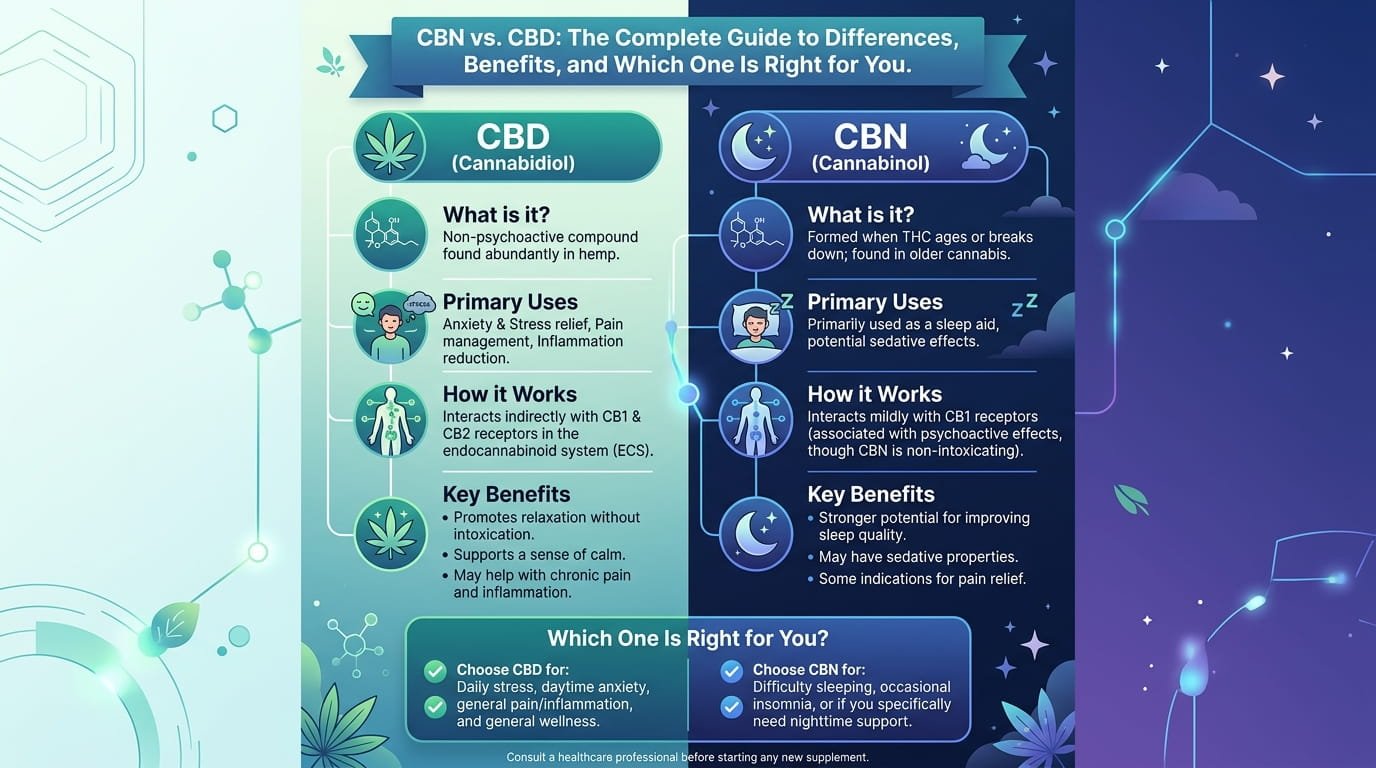
Walk into any wellness store or scroll through a cannabis brand’s website today, and you’ll run into an alphabet soup of letters: CBD, CBN, CBG, CBC, THC. Two of these — CBD and CBN — get compared constantly, and for good reason. They come from the same plant, they share part of their name, and they’re both non-intoxicating in normal doses. But CBD and CBN are not interchangeable. One is the most researched wellness compound on the market. The other is quietly becoming known as “the sleepy cannabinoid.” This guide breaks down CBN vs CBD in plain language — what each one is, how they differ chemically and functionally, how they compare for sleep, pain, and anxiety, and how CBG, CBC, and THC fit into the bigger cannabinoid picture.
What Is CBD?
CBD, or cannabidiol, is one of the most abundant cannabinoids found naturally in the hemp and cannabis plant, often making up 15–20% of dried flower weight. It is extracted directly from the plant rather than formed through a chemical transformation, which is one of the first things that separates the CBD vs CBN conversation.
CBD does not produce a high. It interacts with the body’s endocannabinoid system (ECS), a network of receptors — mainly CB1 and CB2 — that helps regulate mood, sleep, pain perception, appetite, and immune response. Interestingly, CBD doesn’t bind strongly to CB1 or CB2 receptors the way THC does. Instead, it works more indirectly, influencing how the ECS functions and how other cannabinoids behave within it.
Because CBD has been studied far more extensively than any other minor cannabinoid, it has the broadest evidence base. Research has explored its potential role in anxiety reduction, inflammation, chronic pain, and even seizure disorders — the FDA has approved one CBD-based medication, Epidiolex, for certain forms of epilepsy. That regulatory track record is a big part of why, when people search “what is CBD vs CBN,” CBD tends to come out looking like the more established, general-purpose wellness cannabinoid.
What Is CBN?
CBN, or cannabinol, works differently. Rather than being abundant in fresh plant material, CBN is what THC becomes over time. As THC is exposed to heat, light, and oxygen — through aging, curing, or storage — it gradually degrades into CBN. That’s why older or improperly stored cannabis often tests higher in CBN and lower in potency: the THC has literally converted into something else.
This origin story matters when comparing CBN oil vs CBD oil. Because CBN is derived from THC, it retains a faint structural relationship to it, and in large quantities it can produce mild psychoactive effects — though nowhere near the intensity of THC itself. Most users describe CBN’s effect as gentle sedation or relaxation rather than a noticeable “high.”
CBN also engages with CB1 and CB2 receptors, but its affinity for CB1 is roughly a quarter of THC’s potency. This mild receptor activity, combined with anecdotal reports of drowsiness, is why CBN has picked up its reputation as a nighttime cannabinoid. It’s worth noting, though, that CBN’s research base is much thinner than CBD’s — much of what’s known comes from early studies, animal research, and user-reported outcomes rather than large-scale human trials.
CBN vs CBD: Key Differences at a Glance
The table below sums up the core distinctions people are usually looking for when they compare CBD vs CBN.
| Factor | CBD | CBN |
| Origin | Extracted directly from hemp/cannabis | Forms as THC oxidizes and ages |
| Psychoactivity | Non-psychoactive | Mildly psychoactive in high doses |
| Abundance in plant | High (up to 15–20%) | Very low; increases as cannabis ages |
| Primary reputation | General wellness, calm, daytime use | Sleep support, nighttime use |
| Receptor activity | Indirect ECS modulation, weak CB1/CB2 binding | Weak-to-moderate CB1/CB2 binding |
| Research depth | Extensive, including FDA-approved use | Limited, mostly early-stage |
| Legal status (US) | Federally legal under 2018 Farm Bill (hemp-derived) | Federally compliant if hemp-derived (<0.3% THC), but exists in a legal gray area in some states |
The short version: CBD is the broad, well-studied all-rounder; CBN is the newer, sleep-focused specialist with a much smaller research footprint.
Is CBN or CBD Psychoactive?
Neither CBD nor CBN gets you high the way THC does. CBD is considered completely non-intoxicating — it does not alter perception or mental state. CBN sits in a gray zone: at typical consumer doses it’s non-intoxicating, but because it’s chemically related to THC, very high doses can produce mild psychoactive effects, usually described as heavy relaxation rather than euphoria. If drug testing is a concern, this relationship matters — CBN metabolites can potentially cross-react with standard THC immunoassay tests, so caution is warranted for anyone who is regularly tested.
CBN vs CBD for Sleep
This is probably the single most common reason people search “CBD vs CBN for sleep.” CBD’s role in sleep is mostly indirect — it may help by easing stress, anxiety, and physical discomfort that otherwise get in the way of falling or staying asleep. It isn’t a sedative in the traditional sense.
CBN has built its entire reputation around sleep, but the scientific evidence for CBN vs CBD for sleep is more nuanced than marketing copy suggests. Interestingly, some research indicates that CBN alone may not have particularly strong sedative properties — its calming reputation may come largely from anecdotal reports and from products that combine CBN with other cannabinoids or minor amounts of THC, producing what’s known as the entourage effect. Full-spectrum CBN products, which include trace amounts of other cannabinoids, are frequently reported as more effective for sleep than CBN isolate alone.
This is an important nuance for anyone comparing CBD vs CBN sleep gummies or CBD vs CBN sleep research online: much of the buzz around CBN as a sleep aid is ahead of the clinical data. It’s promising, but it isn’t yet proven with the same rigor as, say, melatonin.
CBD vs CBN vs Melatonin for Sleep
Melatonin is a hormone your body produces naturally to regulate the sleep-wake cycle, and it has decades of clinical research behind its short-term use for issues like jet lag or delayed sleep onset. CBN, by contrast, is thought to work more broadly on relaxation and calm rather than directly resetting your circadian rhythm. Some people find combining low-dose melatonin with CBD or CBN gummies helps with both falling asleep and staying relaxed, but there isn’t strong evidence that CBN outperforms melatonin — the two work through different mechanisms and may suit different sleep problems. Compared with traditional sleep supplements, CBD and CBN gummies tend to produce a gentler, non-habit-forming effect, which is part of their appeal, but users should set realistic expectations rather than treating them as a guaranteed fix for insomnia.
CBN vs CBD for Pain Relief
Both cannabinoids show up in conversations about pain, but they may work through different pathways. CBD’s anti-inflammatory and pain-related effects are thought to stem from its broad influence on the ECS and its interaction with receptors involved in inflammation and pain signaling. It’s the more heavily studied of the two for chronic pain and inflammation-related discomfort.
CBN has also been associated with pain relief and muscle relaxation in early research, and some studies suggest it may be particularly useful for muscle tension or discomfort that interferes with sleep — tying its pain-relief potential back to its sedative reputation. When comparing CBD vs CBN for pain relief, many wellness brands recommend CBD for general, ongoing discomfort and CBN for pain that’s disrupting rest at night, though direct head-to-head clinical comparisons are still scarce.
CBN vs CBD for Anxiety
CBD has a substantial body of research — including studies on generalized anxiety, social anxiety, and stress response — supporting its use for anxiety-related symptoms. It’s typically used during the day precisely because it calms without sedating.
CBN’s anti-anxiety profile is much less established. Because CBN tends to produce drowsiness, it’s generally positioned as a nighttime compound rather than a daytime anxiety aid — the sedation that helps with sleep would likely interfere with daytime functioning. If anxiety is the primary concern, CBD (potentially alongside CBG, which some users report helps with focus and emotional balance without sedation) is generally considered the more appropriate starting point over CBN.
Bringing CBG Into the Picture: CBD vs CBG vs CBN
Once you understand CBD and CBN, the next cannabinoid people usually ask about is CBG (cannabigerol). CBG is sometimes called the “mother cannabinoid” because it’s the chemical precursor from which CBD, THC, and CBC are all synthesized as the cannabis plant matures. Young hemp plants are relatively rich in CBG, but most of it converts into other cannabinoids by the time the plant is fully grown, which is why CBG products tend to be pricier and less widely available.
Where CBD is associated with calm and general wellness, and CBN with sleep, CBG has built a reputation around mental clarity, focus, and gut or digestive comfort. Unlike CBN, CBG is not associated with sedation, so for anyone comparing CBD vs CBG vs CBN for anxiety or focus, CBG is often positioned as the daytime, non-drowsy option, CBD as the flexible middle ground, and CBN as the nighttime specialist.
For sleep specifically, CBD vs CBG vs CBN comparisons generally still favor CBN and CBD as the more established choices, with CBG playing a smaller supporting role. Many full-spectrum tinctures now combine all three in a single formula — sometimes marketed as a 1:1:1 ratio — precisely to capture calm, focus, and rest in one product.
The Full Lineup: CBD vs CBG vs CBN vs CBC
Add a fourth cannabinoid — CBC, or cannabichromene — and you get the complete “minor cannabinoid” comparison that’s increasingly common in 2026 product marketing: CBD vs CBG vs CBN vs CBC.
CBC is the least studied of the four and isn’t usually extracted from hemp flower directly; it’s typically derived from CBGA, the same precursor molecule that gives rise to CBG. Like the others, CBC is non-intoxicating. Early, limited research has looked at CBC’s potential role in mood support, inflammatory pain, and skin health, and some preliminary studies have explored possible neuroprotective and anti-cancer properties, though this evidence is far from conclusive.
At the receptor level, CBC behaves differently from the other three. Rather than binding strongly to CB1 and CB2, it appears to interact more with TRPV1 and TRPA1 receptors — pathways linked to pain and inflammation perception. This is part of why some researchers believe CBC could eventually prove useful for inflammatory pain specifically, in contrast to CBD’s broader, more generalized effects.
Putting the four side by side:
- CBD — the broad-spectrum wellness cannabinoid: calm, balance, general pain and inflammation support, backed by the most research.
- CBG — the “mother” cannabinoid: associated with focus, mental clarity, and possible digestive and neuroprotective benefits.
- CBN — the sleep-focused cannabinoid: formed from aged THC, mildly sedating, best known for nighttime use.
- CBC — the emerging cannabinoid: limited on its own, but of interest for inflammatory pain, mood, and skin health, especially in combination with other cannabinoids.
None of these four appear to work best in isolation. Most of the research and product formulation around CBD, CBG, CBN, and CBC points toward an “entourage effect,” where cannabinoids taken together may produce a stronger or more well-rounded result than any single compound alone.
THC vs CBD vs CBN: Where Does THC Fit In?
It’s worth being clear about how THC fits into the CBN vs CBD conversation, since CBN is chemically derived from THC. THC (tetrahydrocannabinol) is the cannabinoid responsible for the psychoactive “high” associated with cannabis. It binds strongly and directly to CB1 receptors in the brain, which is what produces euphoria, altered perception, and intoxication.
CBD, as covered above, does not produce intoxication. CBN, being THC’s degradation product, keeps a faint structural echo of THC and can be mildly psychoactive at high doses, but it is nowhere near as potent — its CB1 activity is estimated at roughly a quarter of THC’s. In terms of legal status, this distinction matters: THC remains a Schedule I controlled substance under U.S. federal law, though many states permit recreational or medical use, while hemp-derived CBD and CBN (with less than 0.3% delta-9 THC) are generally federally compliant under the 2018 Farm Bill, even though CBN’s legal status varies more by state since it isn’t explicitly named as a permitted hemp derivative everywhere.
Some products intentionally combine small, legal amounts of THC with CBD and CBN — the idea being that a little THC may enhance CBN’s sedative effect through the entourage effect discussed earlier. Always check your state’s specific regulations before purchasing any THC-containing product.
CBD vs CBN Products: Oils, Gummies, and Patches
Both cannabinoids are sold in similar formats, but how people use them tends to differ:
- CBD oil vs CBN oil: CBD oils are typically used throughout the day, added to routines the way you might use a daily supplement. CBN oils are almost always marketed and taken specifically at bedtime.
- CBD vs CBN gummies: Gummies are popular for both, largely because they offer consistent, pre-measured dosing. CBD gummies skew toward daytime calm; CBN gummies (often blended with CBD or melatonin) are formulated as sleep aids.
- CBD vs CBN patch: Transdermal patches deliver a slow, steady release over several hours, which some users prefer for overnight use since it avoids the peak-and-drop effect of gummies or tinctures.
Whichever format you choose, product quality varies enormously across the CBD and CBN markets. Independent lab testing has repeatedly found products with less active cannabinoid than advertised, and occasionally undisclosed THC content. Always look for a current third-party Certificate of Analysis (COA) before buying.
Safety and Side Effects
CBD is generally well tolerated, but it isn’t free of side effects. Commonly reported issues include dry mouth, drowsiness, changes in appetite, digestive upset, and fatigue. In rarer cases, high doses have been linked to liver enzyme changes, so anyone on other medications — especially blood thinners — should talk to a doctor first, since CBD can interact with how the liver metabolizes certain drugs.
CBN’s side-effect profile is less thoroughly documented simply because it has been studied far less. Reported effects generally mirror mild sedation: grogginess, particularly if taken during the day, and the mild psychoactive potential mentioned earlier at high doses. As with CBD, quality and dosing consistency are real concerns — because CBN products are newer and less regulated, potency claims on labels should be treated with a degree of caution until backed by lab testing.
Neither cannabinoid is regulated by the FDA for general wellness use (aside from CBD’s one approved epilepsy medication), so neither should be treated as a substitute for medical treatment of a diagnosed condition.
How to Choose Between CBD and CBN
The right choice really comes down to what you’re trying to solve:
- Daytime calm, general stress, or ongoing wellness support → CBD.
- Trouble winding down or staying asleep at night → CBN, often paired with CBD.
- Focus and mental clarity without drowsiness → CBG, alongside or instead of CBD.
- Inflammatory pain or interest in emerging research → CBC, typically combined with CBD or CBG.
- Want the broadest possible effect → a full-spectrum product combining several cannabinoids to take advantage of the entourage effect.
As always, start with a low dose, especially with CBN, since its sedative effect can vary noticeably from person to person, and increase gradually while paying attention to how you feel.
Frequently Asked Questions
What is CBN vs CBD, in one sentence?
CBD is a non-psychoactive, well-researched cannabinoid extracted directly from hemp and used for general wellness, while CBN is a mildly psychoactive cannabinoid formed as THC ages, best known for sleep support.
Is CBN stronger than CBD?
Not exactly — they aren’t measuring the same thing. CBN has mild activity at CB1 receptors, while CBD doesn’t directly activate CB1 at all. For sleep specifically, CBN may feel more noticeable, but CBD has broader applications and considerably more clinical evidence behind it.
Can I take CBD and CBN together?
Yes. Many users combine them intentionally — CBD during the day for calm and balance, CBN at night for rest — and full-spectrum products often blend the two (sometimes with CBG or trace THC) to take advantage of the entourage effect.
Will CBN show up on a drug test?
It’s possible. Because CBN is chemically related to THC, its metabolites can potentially cross-react with standard THC immunoassay screens. If you’re subject to regular drug testing, this is worth discussing with your employer or testing provider before using CBN products.
Which is better for sleep: CBD, CBN, or melatonin?
There’s no universal answer. Melatonin has the most clinical backing for regulating the sleep-wake cycle short-term. CBN is popular anecdotally for relaxation and sleep, though rigorous evidence is still developing. CBD may help indirectly by easing stress or discomfort that disrupts sleep. Some people find a combination works better than any single option alone.
Conclusion
CBD and CBN may share a name and a plant of origin, but they’re built for different jobs. CBD is the broad, extensively studied wellness cannabinoid suited to daytime use, general calm, and ongoing support. CBN is the newer, sleep-oriented cannabinoid formed as THC breaks down, with a smaller but growing body of research behind its calming, sedative reputation. Add CBG for focus and CBC for its emerging anti-inflammatory potential, and you get a fuller toolkit of non-intoxicating cannabinoids, each suited to a slightly different goal. As research on CBN, CBG, and CBC continues to mature through 2026 and beyond, expect the picture to get clearer — but for now, matching the cannabinoid to your specific goal, starting with a low dose, and choosing lab-tested products remains the most reliable approach.
This article is for general informational purposes only and is not medical advice. Consult a healthcare professional before starting any cannabinoid product, especially if you take other medications or have an underlying health condition.