If you have ever paused mid-sentence, unsure whether to write “verbiage” or “verbage,” you are far from alone. This is one of the most commonly searched spelling questions in English writing circles, and for good reason — the word sounds like it could go either way. People type “verbage vs verbiage,” “verbiage vs verbage definition,” and even “verbiage vs verbage reddit” into search engines every single day, hoping to find a clear, final answer.
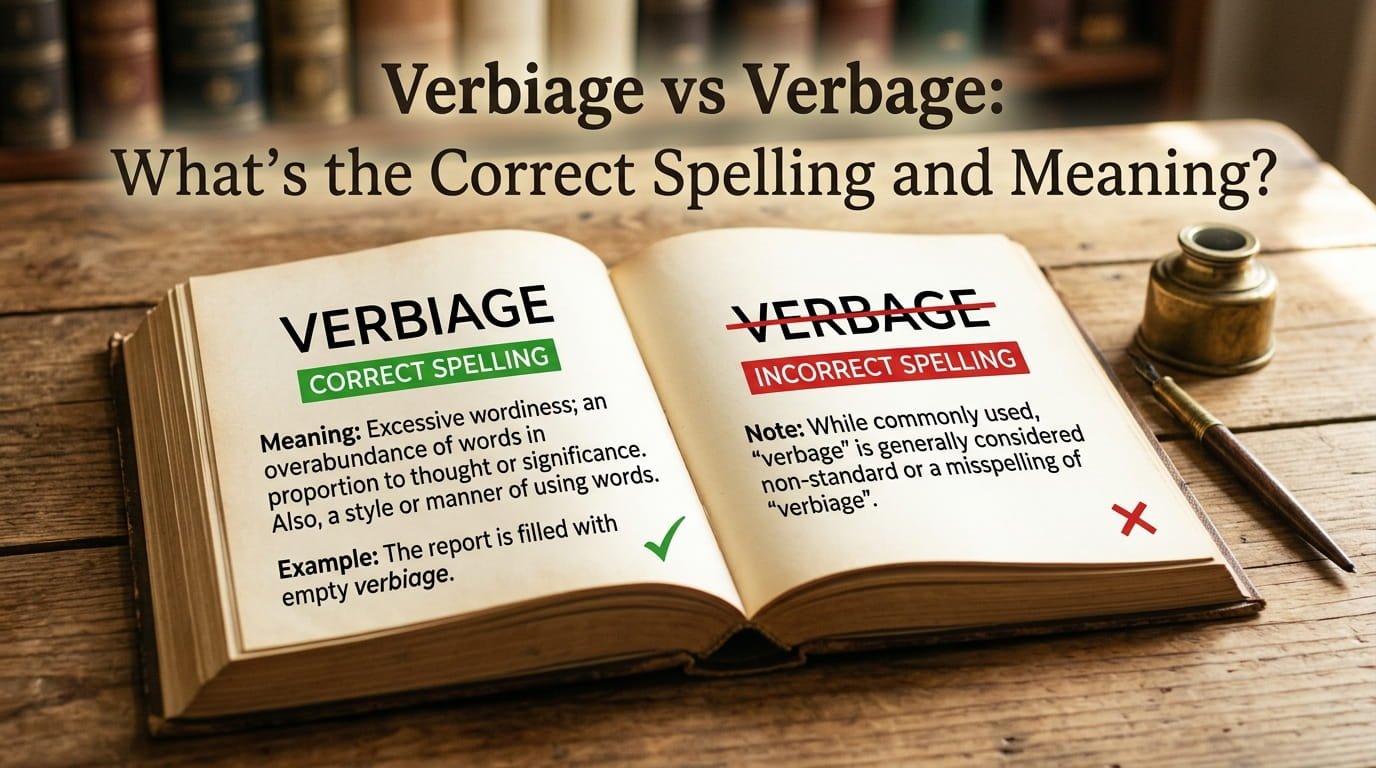
The short version: verbiage is correct, and verbage is not a real word. But that one-line answer doesn’t explain why so many people get it wrong, where the confusion started, how to use verbiage correctly in a sentence, or what to do if you’ve been writing “verbage” in professional emails for years (don’t worry, it’s an easy fix).
This article breaks down everything you need to know about verbiage vs verbage — the definition, the grammar, the history, real-world examples, and the psychological reason your brain keeps wanting to drop that “i.” By the end, you’ll never have to second-guess this word again.
Verbiage vs Verbage: The Quick Answer
Let’s settle the core question immediately, since that’s likely why you’re here.
- Verbiage — correct in both American and British English.
- Verbage — incorrect in every context, in every English-speaking country, in both formal and informal writing.
There is no such thing as “verbag vs verbiage” being two valid alternatives, no “verbiage vs verbage vs verbiage” debate to be had, and no regional variant where “verbage” becomes acceptable. This isn’t a British-versus-American spelling situation like “colour” and “color.” It’s simply one correct word and one common misspelling that has stuck around because of how the word sounds when spoken aloud.
If you remember nothing else from this article, remember this: whenever you mean “excessive or unnecessary wording,” the word you want is verbiage.
What Does Verbiage Mean?
Before going further into the verbage vs verbiage grammar debate, it helps to properly understand what the word actually means, since correct spelling only matters if you’re using the word correctly in the first place.
Verbiage (pronounced VUR-bee-ij, not VUR-bij) is a noun that refers to:
- Language that uses more words than necessary — wordy, inflated, or overly complex speech or writing.
- More neutrally, it can simply mean “the wording” or “the specific language” used in a document, without any negative judgment attached.
So verbiage carries two shades of meaning depending on context:
- Negative/critical sense: “This report is full of verbiage” implies the writing is bloated, repetitive, or unnecessarily complicated.
- Neutral/descriptive sense: “Please update the verbiage on the homepage” simply means “update the text/wording,” with no judgment about whether it’s too long.
This second, more neutral usage is extremely common in corporate and marketing environments. You’ll often hear phrases like “let’s tweak the verbiage in the email” or “the legal team wants to review the verbiage in the contract.” In these cases, “verbiage” is functioning almost as a synonym for “wording” or “copy,” rather than as a criticism.
Etymology: Where Does “Verbiage” Come From?
Understanding the origin of the word makes the correct spelling much easier to remember. Verbiage entered the English language in the 18th century through French. It traces back to the French word verbier, meaning “to chatter” or “to warble,” which itself connects to the Latin root verbum, meaning “word.”
This etymology is genuinely useful for remembering the spelling: since the word is built from “verb” + “iage,” breaking it down as verb + i + age gives you an easy mental checkpoint. If you ever find yourself typing “verbage,” pause and ask: where did the “i” go? The “i” isn’t optional — it’s part of the word’s structural DNA, tracing all the way back to its French and Latin roots.
Notice also that verbiage does not change spelling between American English and British English. Unlike words such as “colour/color” or “organise/organize,” there is no British form called “verbage.” Across every English-speaking region — the US, UK, Canada, Australia — verbiage is the only accepted spelling.
Why Do So Many People Write “Verbage” Instead?
If verbiage is so clearly correct, why does “verbage” show up constantly in emails, reports, forum posts, and even some published content? The answer lies in phonetics, not logic.
1. It Sounds Like Other “-age” Words
English has a large family of common two-syllable words ending in “-age”: garbage, baggage, voyage, wreckage, postage, package, message. When people hear the word “verbiage” spoken quickly — especially in fast corporate speech — their brain unconsciously tries to fit it into this familiar two-syllable “-age” pattern. The three-syllable “ver-bee-ij” gets compressed into the more familiar-sounding two-syllable “ver-bij,” and when it’s time to write it down, “verbage” comes out instead.
2. Confusion With “Verbal”
Another theory is that “verbage” arises from a blend of “verbiage” and “verbal,” two words that are conceptually related (both concern language and speech) and share a similar beginning. When your brain is holding both words in mind, it’s easy for the spelling of one to bleed into the other.
3. It’s Genuinely an Old Mistake, Not a New Internet Trend
Interestingly, “verbage” isn’t just a modern typo born from autocorrect or texting culture. Language historians have traced sporadic use of “verbage” as far back as the 1800s. It has never been accepted as standard English, but it has persisted quietly for two centuries simply because of how naturally it rolls off the tongue. According to usage data cited in Garner’s Modern English Usage, in printed material, “verbiage” outnumbers “verbage” by more than 100 to 1 — meaning the correct form has always dominated, even if “verbage” refuses to fully disappear.
4. Corporate and Marketing Speak Normalizes It
“Verbiage” is a favorite word in office environments — “let’s leverage the verbiage from last year’s proposal,” “can you send over the verbiage for the landing page?” Because it’s used so frequently and often quickly in meetings, spoken mispronunciations spread fast, and once a few people start writing “verbage” in shared documents, it gets copy-pasted and repeated without anyone stopping to check.
Is “Verbage” Ever Acceptable?
No — and this deserves a direct answer because so many searches (verbage vs verbiage meaning, verbage vs verbiage definition) are really asking, “is there any situation where verbage is okay?”
There isn’t. Verbage is not: 16093922992
- A regional British spelling
- An informal or casual variant
- An accepted alternate spelling in any major dictionary (Merriam-Webster, Oxford, Cambridge)
- A newer, evolving form of the word that’s gradually becoming standard
It is simply a misspelling — no different from writing “recieve” instead of “receive,” or “definately” instead of “definitely.” The fact that it’s a common misspelling doesn’t make it a correct one. Dictionaries have not adopted it as a recognized variant, and spell-checkers will consistently flag it.
If you’re wondering whether using “verbage” might make your writing sound more casual or conversational, the opposite is actually true — it tends to signal a lack of attention to detail, which can quietly undermine your credibility in professional and academic writing.
Verbiage vs Verbage: Why the Correct Spelling Matters
You might be thinking: does one letter really matter that much? In casual texting, probably not. But in professional, academic, and published writing, small spelling errors carry more weight than people expect.
1. Credibility and Professionalism
When “verbage” appears in a business proposal, legal document, marketing copy, or academic paper, it can undercut the writer’s credibility — especially since the word itself is often used specifically in contexts where precision and polish matter (legal contracts, official reports, editorial content). A reader who notices the misspelling may start scrutinizing the rest of the document more critically.
2. Search and SEO Confusion
Because so many people misspell the word, “verbage” generates enormous search volume — which is part of why terms like “verbage vs verbiage,” “verbiage vs verbage definition,” and “verbage vs. verbiage” are so heavily searched. Content creators and businesses need to understand this dynamic: it’s fine to acknowledge “verbage” as a common search term for SEO purposes, but the actual word used in your content should always be “verbiage.”
3. Spell-Check and Editing Tools
Most modern spell-checkers (Microsoft Word, Google Docs, Grammarly) will flag “verbage” as an error and suggest “verbiage.” If you’re relying on spell-check to catch it, you’re generally safe — but it’s still worth training your own memory so you’re not dependent on software every time.
How to Remember the Correct Spelling: Verbiage, Not Verbage
Here are several memory tricks — pick whichever resonates with you:
Trick 1: The Length Rule Verbiage literally means “excessive wording” — and appropriately, it’s the longer of the two spellings. If you remember that the word about “too many words” itself has “extra” letters compared to the incorrect version, it can help cement the correct form.
Trick 2: Break It Into Three Parts Split the word into verb + i + age. You already know how to spell “verb” and “age” — just don’t forget the “i” that connects them.
Trick 3: Think of “Verb-y” Since verbiage describes speech that’s overly wordy, try associating it with being “verb-y” — full of verbs and words. This nonsense mnemonic can jog your memory toward the “verb” root and the “i” that follows it.
Trick 4: Compare It to “Marriage” or “Carriage” Words like “marriage” and “carriage” also follow a similar “-riage/-biage” sound pattern with an “i” before the final syllable. If you can spell those correctly, apply the same logic to verbiage.
Trick 5: Say It Correctly First Since much of the confusion stems from mispronunciation, practicing the correct three-syllable pronunciation — VUR-bee-ij — can help your spelling naturally follow suit. If you say it with all three syllables clearly, “verbage” becomes much harder to accidentally write.
Verbiage in a Sentence: Real Examples
Seeing the word used correctly in context is often the fastest way to internalize it. Here are examples across different tones and settings:
Formal/Legal:
- “The contract contains unnecessary verbiage that could be simplified without changing its legal meaning.”
- “Critics argued that the bill was weighed down by excessive legal verbiage.”
Business/Corporate:
- “Can you review the verbiage on the pricing page before we publish it?”
- “Let’s cut the verbiage in this email and get straight to the ask.”
- “The marketing team wants to update the verbiage across all our social media bios.”
Academic:
- “Academic papers should avoid unnecessary verbiage that obscures the core argument.”
- “The professor marked down the essay for verbiage that added length without adding substance.”
Everyday/Conversational:
- “The instructions on this new phone are full of verbiage that nobody actually reads.”
- “Despite all the verbiage in his explanation, the basic idea was actually quite simple.”
Neutral/Descriptive (no negative connotation):
- “Please send me the exact verbiage you’d like used in the announcement.”
- “The design is ready — we just need final verbiage from the copywriting team.”
Notice how in several of these examples, “verbiage” doesn’t necessarily mean something negative — it can simply mean “the wording” or “the text,” which is one of the more nuanced aspects of how native speakers actually use the term today.
Synonyms for Verbiage
If you want to vary your language or you’re not sure “verbiage” is quite the word you’re looking for, here are close synonyms, depending on which meaning you intend:
For the negative sense (too many words):
- Verbosity
- Wordiness
- Padding
- Redundancy
- Prolixity
- Loquacity
For the neutral sense (the actual wording/text):
- Phrasing
- Wording
- Copy
- Language
- Text
Choosing the right synonym depends on tone. “Verbosity” and “prolixity” sound more formal and critical, while “wording” and “copy” are neutral and commonly used in editorial or marketing contexts.
Common Mistakes Related to Verbiage vs Verbage
Beyond the basic spelling error, here are a few related mistakes worth knowing about:
- Dropping the “i” entirely — writing “verbage” instead of “verbiage.” This is the single most common error.
- Mispronouncing it as two syllables — saying “VUR-bij” instead of the correct three-syllable “VUR-bee-ij,” which often leads directly to the spelling mistake.
- Assuming it’s a British/American variation — as covered earlier, there is no regional version where “verbage” is correct.
- Using “verbiage” when you actually mean “vocabulary” or “terminology” — verbiage refers to wordiness or wording, not to a specific set of technical terms. If you mean “the specific words/terms used in a field,” “terminology” is often the more precise choice.
- Confusing it with “verbatim” — “verbatim” means “word for word, in exactly the same words,” which is a completely different meaning from “verbiage.” The similarity in spelling sometimes causes writers to blend the two concepts.
Verbiage vs Verbage: Frequently Asked Questions
Is verbiage ever spelled “verbage” correctly? No. In every English dictionary and style guide, “verbiage” is the only correct spelling. “Verbage” is always considered a spelling error.
Is “verbage” a British English variant of “verbiage”? No. This word does not change between American and British English. Verbiage is used identically in both.
Why do people write “verbage” so often, then? Mostly because of pronunciation. The three-syllable word “verbiage” often gets spoken as if it were a two-syllable word (like “garbage” or “postage”), and that mispronunciation carries over into spelling.
What does verbiage mean in simple terms? It means “too many words,” or more neutrally, “the specific wording or text used” in a piece of writing.
Is verbiage a negative word? It can be, depending on context. “Full of verbiage” is a criticism of wordiness. But phrases like “update the verbiage” are neutral and simply refer to the text itself.
How do you pronounce verbiage? It’s pronounced VUR-bee-ij — three syllables, not two.
Can I use “verbiage” to mean “vocabulary”? Not accurately. Verbiage refers to wordiness or the wording used, not to a specialized set of terms — that’s what “terminology” or “vocabulary” mean instead.
Does spell-check catch “verbage”? Yes, in almost all modern word processors and browsers, “verbage” is flagged as a misspelling, with “verbiage” suggested as the correction.
Verbiage in Different Professional Fields
The word “verbiage” shows up differently depending on the industry, and understanding these contexts can help you use it more naturally and confidently.
Legal Writing
In law, “verbiage” often carries a mildly critical tone, referring to overly dense or convoluted contract language that could be simplified without losing legal meaning. Lawyers and legal editors frequently talk about “reducing verbiage” or “cutting boilerplate verbiage” when revising contracts, terms of service, or court filings. Plain-language advocates within the legal profession have spent decades pushing back against unnecessary verbiage, arguing that clearer contracts protect both clients and the public.
Marketing and Advertising
In marketing, “verbiage” is used almost exclusively in its neutral sense — as a synonym for “copy” or “text.” A marketing manager might ask a copywriter to “send over the verbiage for the new landing page” or say “the client wants to tweak the verbiage in the ad.” Here, there’s no implication that the writing is too long; it simply refers to whatever words will appear in the final piece.
Academic and Technical Writing
In academic contexts, verbiage almost always carries a negative connotation. Professors and journal reviewers use it to describe writing that pads out an argument with unnecessary words instead of communicating ideas efficiently. Reducing verbiage is often cited as one of the most effective ways to strengthen an academic paper, since dense, wordy sentences can obscure otherwise strong research and arguments.
Corporate Communication
In offices and corporate settings, verbiage is a favorite piece of jargon itself — ironically, a word about excessive wording has become a staple of corporate-speak. Phrases like “let’s align on the verbiage” or “can legal sign off on this verbiage” are extremely common in day-to-day business communication, often used simply to mean “wording” without any judgment attached.
A Brief History of Word Confusion Like This
Verbiage vs verbage isn’t an isolated case — English is full of similar situations where a mispronunciation eventually produces a written variant that never becomes accepted. Consider a few parallels:
- “Espresso” vs “expresso” — the correct word is “espresso,” yet “expresso” persists because it sounds more familiar to English speakers used to words like “express.”
- “Nuclear” vs “nucular” — a mispronunciation that’s extremely common in speech but never accepted in writing.
- “Supposedly” vs “supposably” — another case where a spoken shortcut created a written error that dictionaries have never recognized.
What connects all of these cases, including verbiage vs verbage, is that the incorrect form usually emerges because it’s easier to say or because it matches a more familiar sound pattern already present in the language. Linguists sometimes call this kind of shift a “folk etymology” pattern, even when — as with “verbage” — no genuinely new meaning develops, just an error that spreads through repetition.
Understanding this pattern is useful because it explains why “verbage” doesn’t feel entirely foreign when you read it. Your brain recognizes the “-age” ending from dozens of legitimate words, which is exactly why the mistake is so easy to make and so hard to permanently unlearn without a deliberate memory trick.
How to Fix “Verbage” if You’ve Been Using It
If you’ve realized you’ve been writing “verbage” in documents, emails, or published content for a while, here’s a simple plan to correct it going forward:
- Do a search-and-replace. In any existing documents, templates, or saved email drafts, use “Find and Replace” to swap every instance of “verbage” with “verbiage.”
- Update your personal dictionary. If you’ve ever told your spell-checker to “ignore” or “add to dictionary” for the word “verbage,” undo that setting so the tool starts flagging it again.
- Practice the three-syllable pronunciation. Saying the word correctly out loud — ver-bee-ij — a few times can help retrain the automatic spelling that follows when you type it.
- Use the “verb + i + age” trick whenever you’re unsure, especially in fast-paced writing like emails or chat messages where typos are common.
- Proofread specifically for this word if you know it’s a personal habit. A quick manual check before sending important documents can catch what spell-check occasionally misses, especially in older software.
None of this requires much effort — it’s really just a matter of building a small, permanent mental checkpoint around one specific word.
Final Thoughts: Verbiage vs Verbage
The debate around verbiage vs verbage isn’t really a debate at all — it’s a case of one correct word and one persistent, centuries-old misspelling that survives because of how the word sounds when spoken quickly. Whether you’re writing a business email, an academic paper, a legal document, or just a text message, the rule stays the same:
If you mean “wordiness” or “the specific wording used,” the correct spelling is always verbiage — never verbage.
Understanding the word’s French and Latin roots, practicing the correct three-syllable pronunciation, and using a simple memory trick like breaking it into “verb + i + age” will make sure you never hesitate over this word again. Small details like this might seem minor, but in professional and academic writing, correct spelling is often the difference between writing that reads as polished and credible, and writing that quietly loses the reader’s trust.
So the next time you’re drafting an email, editing a report, or writing content for a website, and you find yourself wondering “is it verbiage or verbage?” — you’ll already know the answer.
Table of content
- Etymology: Where Does “Verbiage” Come From?
- 1. It Sounds Like Other “-age” Words
- 2. Confusion With “Verbal”
- 3. It’s Genuinely an Old Mistake, Not a New Internet Trend
- 4. Corporate and Marketing Speak Normalizes It
- 1. Credibility and Professionalism
- 2. Search and SEO Confusion
- 3. Spell-Check and Editing Tools
- Legal Writing
- Marketing and Advertising
- Academic and Technical Writing
- Corporate Communication