If you have ever paused mid-sentence wondering whether the word is versatile, varsatile, or versetile, you are not alone. This single adjective — used constantly in resumes, product descriptions, school essays, and casual conversation — trips people up more often than its short length suggests. In this guide, we will settle the spelling question once and for all, break down the versatile definition, explain how to pronounce versatile correctly, trace its origins, and explore how the word shows up in real life — from versatile strollers for growing families to versatile purses that carry you from the office to a night out.
By the end, you will not only know what is versatile in the dictionary sense, but also how to use the word with confidence in your own writing.
Versatile: Spelling It Correctly the First Time
Let’s address the elephant in the room right away, because it’s the reason most people search for this word in the first place.
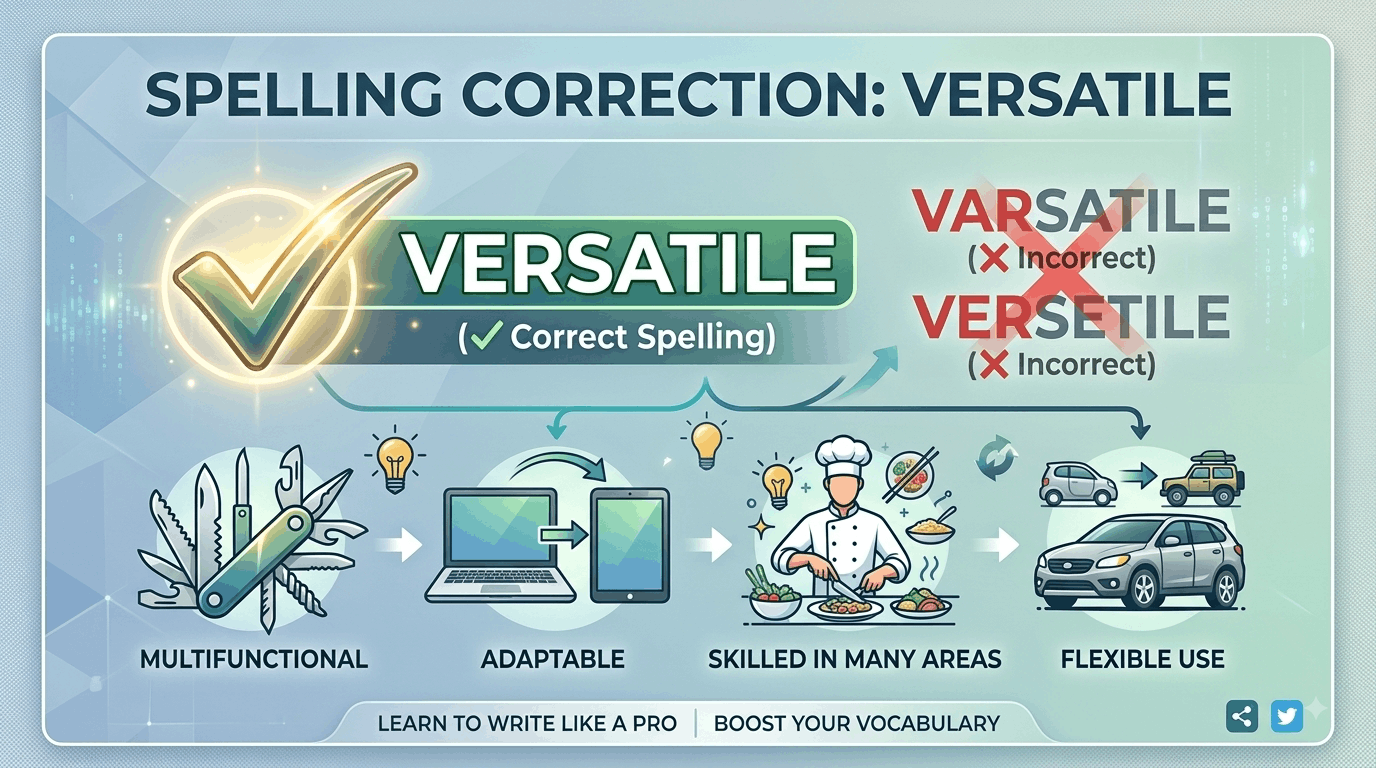
The correct spelling is versatile. Not “varsatile.” Not “versetile.” Just versatile — v-e-r-s-a-t-i-l-e.
Varsatile and versetile are two of the most common misspellings of this word, and both are understandable mistakes. English spelling doesn’t always match pronunciation, and “versatile” is a textbook example of a word where the vowels can easily get swapped in a writer’s mind. Let’s look at why each misspelling happens and why it’s incorrect.
Why People Write “Varsatile” Instead of “Versatile”
The varsatile spelling likely comes from how the first syllable sounds when spoken quickly. In casual speech, the “er” sound in “ver-” can come across as an “ar” sound, especially in certain regional accents. Since English speakers often spell words the way they hear them (a habit linguists call phonetic spelling), it’s easy to see how “ver” morphs into “var” on the page. However, there is no dictionary, style guide, or standard reference that recognizes varsatile as a legitimate variant. If you search for a define versetile or varsatile entry in Merriam-Webster, Oxford, or Cambridge, you will find nothing — because the correct entry sits under “versatile.”
Why People Write “Versetile” Instead of “Versatile”
The versetile misspelling has a slightly different root. Many English speakers are more familiar with the word “verse” (as in poetry or song lyrics) than with the Latin-derived root “versa-.” Because “verse” is a common, everyday word, the brain sometimes autocorrects “versa” to “verse” when spelling from memory, producing “versetile” instead of “versatile.” Again, if you look for a versetile definition or meaning of versetile in any recognized dictionary, you won’t find a separate entry — it redirects, if anything, to “versatile,” or simply returns no results at all.
So to be perfectly clear: whether you were about to type varsatile or versetile, the word you’re looking for is versatile, and that is the spelling to use in essays, resumes, product listings, and everyday writing.
Versatile Definition: What Does the Word Actually Mean?
Now that the spelling is settled, let’s dig into the versatile meaning itself.
At its core, dictionaries agree that something is versatile when it can adapt easily to different uses, situations, or functions. Merriam-Webster’s definition centers on two main ideas: having many uses or applications, and being able to turn with ease from one task, subject, or skill to another. Oxford’s definition adds a second layer, describing versatile as applying either to a person who is able to do many different things, or to an object, food, or material that has many different uses.
Put simply, when someone asks what is versatile, the honest answer is: flexibility. A versatile person, tool, or product isn’t locked into a single purpose — it bends, adapts, and performs well across a variety of contexts.
Versatile Meaning in Different Contexts
The meaning versatile carries can shift slightly depending on what it’s describing:
- A versatile person: Someone skilled across multiple areas. A versatile employee might handle marketing, customer service, and light bookkeeping equally well. A versatile actor convincingly plays comedic and dramatic roles in the same career.
- A versatile object or tool: Something designed for multiple uses. A Swiss Army knife is versatile because it functions as a blade, screwdriver, and bottle opener all in one.
- A versatile food: Ingredients that work in many different dishes. Eggs, for example, are often cited as a versatile food because they can be boiled, fried, baked into desserts, or whisked into sauces.
- A versatile material or design: Something engineered for adaptability, such as furniture that reconfigures for different rooms, or fabric that performs well in both hot and cold weather.
- A versatile skill set: A combination of abilities that transfers well across industries, such as project management, communication, or coding.
Whichever context you’re working in, the underlying idea stays the same: versatile always points back to adaptability and range.
How to Pronounce Versatile
Getting the spelling right is only half the battle — many people also want to know how to pronounce versatile correctly, especially since mispronunciation is often what leads to the misspellings in the first place.
In American English, versatile is typically pronounced as three syllables: VUR-suh-tuhl (phonetically, /ˈvɜːrsətəl/). In British English, the final syllable is often pronounced with a longer “eye” sound, closer to VUR-suh-tyle (/ˈvɜːsətaɪl/). Both pronunciations are considered correct; the difference is simply a matter of regional accent, similar to how “mobile” is pronounced differently in the US and UK.
Breaking it down syllable by syllable:
- Ver — rhymes with “her,” not “var.” This is the syllable most often mispronounced or misspelled as “var.”
- Sa — a soft, quick “suh” sound.
- Tile — in American English, this often softens to “tuhl”; in British English, it holds the fuller “tile” sound, like the word for a ceramic floor tile.
If you keep that first syllable — “ver,” not “var” — firmly in mind, you’ll naturally avoid both the pronunciation slip and the varsatile spelling mistake that tends to follow it.
The Origin and History Behind “Versatile”
Understanding where a word comes from often makes it much easier to spell and use correctly, and versatile has a particularly rich backstory.
The word traces back to the Latin versatilis, meaning “turning around” or “revolving,” which itself comes from versare, “to turn repeatedly,” and ultimately from vertere, “to turn.” That root — “to turn” — is the thread that ties the entire meaning together. Something versatile can “turn” easily from one use, task, or role to another, much like the Latin root suggests.
English absorbed the word from French in the early 1600s, and it initially carried a slightly different connotation — describing something inconstant or fluctuating, changing direction easily (in a sometimes negative sense, similar to “fickle”). Over the following centuries, the meaning softened and shifted toward the positive, capability-focused sense we use today: someone or something that handles a variety of tasks well.
This shift from “changeable” to “adaptable and capable” is a great example of how English words evolve. What started as a description of instability became a compliment describing flexibility and skill — which is exactly why calling someone “versatile” today is almost always a form of praise.
It’s worth noting that in specialized fields, “versatile” kept closer to its original “turning” sense. In botany, a versatile anther is one that is attached loosely enough at its midpoint to swing freely. In zoology, a versatile toe (seen in some birds) is one that can rotate forward or backward, giving the bird more flexibility in how it grips branches. These technical uses are less common in everyday speech, but they show just how consistently the “turning” and “flexibility” theme runs through every branch of the word’s meaning.
Versatile in Everyday Language: Example Sentences
Seeing the word in context is often the fastest way to lock in both the spelling and the meaning. Here are several examples of “versatile” used naturally:
- She is one of the most versatile singers in the industry, moving effortlessly between jazz, pop, and classical music.
- The company is looking for a versatile employee who can manage social media, write copy, and assist with basic design work.
- This backpack is incredibly versatile — it works for hiking, daily commuting, and even as a carry-on for flights.
- Olive oil is a versatile ingredient, equally at home in salad dressings, marinades, and baking recipes.
- His versatile coaching background, spanning three different sports, made him the ideal candidate for the athletic director position.
- The software update made the app far more versatile, adding features for photographers, video editors, and casual users alike.
Notice that in every case, the sentence points to the same underlying idea: adaptability across multiple uses, roles, or situations.
Versatile Strollers: Adaptability for Growing Families
One of the clearest real-world examples of “versatile” in action is the modern baby stroller market. Parents shopping for versatile strollers are looking for a single product that can adapt as their child grows and as their lifestyle changes — rather than needing to buy a new stroller for every stage.
A truly versatile stroller typically offers several forms of flexibility:
- Modular seating: Many modular strollers can convert from a single stroller into a double stroller with the addition of a second seat, or reconfigure to work as a bassinet, a toddler seat, or even a stand-on attachment for an older sibling — extending the stroller’s usefulness across several years and multiple children rather than just one.
- Travel system compatibility: A number of versatile stroller frames are designed to accept an infant car seat directly, letting parents move a sleeping baby from car to stroller without waking them, while also functioning as a standalone stroller once the child outgrows the infant seat.
- Terrain adaptability: Suspension systems and larger, air-filled tires allow a single stroller to handle smooth sidewalks, park trails, and uneven pavement equally well, so parents don’t need a separate stroller for city errands versus outdoor walks.
- Compact folding for travel: Some of the most versatile options fold down small enough to fit in an airplane overhead bin or a car trunk, making them equally useful for daily errands and long-distance travel.
Because strollers are a significant investment, this kind of built-in flexibility genuinely matters to parents. A stroller marketed as versatile is essentially promising longevity and range: it should be able to serve a newborn, a toddler, and — in some cases — a second child, all with one core frame. This is precisely why “versatile” shows up so frequently in stroller product descriptions and buying guides: it’s shorthand for “this one purchase will keep working for you as your needs change.”
Versatile Purses: One Bag for Every Occasion
The same principle that applies to strollers applies just as naturally to fashion — particularly to versatile purses. In the world of handbags, “versatile” is one of the highest compliments a bag can receive, because it signals that the item earns its place in a wardrobe rather than sitting unused after the first few wears.
A few qualities tend to define a genuinely versatile purse:
- Neutral color palette: Shades like black, tan, cream, and deep brown pair easily with a wide range of outfits, making the bag suitable for both casual and formal settings without clashing.
- Adaptable size: A mid-sized bag that comfortably fits daily essentials — without being so large it feels bulky for evening wear or so small it’s impractical for daytime use — tends to work across the widest range of occasions.
- Convertible straps: Many versatile purses include a detachable or adjustable strap, allowing the same bag to function as a crossbody for running errands, a shoulder bag for the office, or a clutch for dinner.
- Durable, simple materials: Classic leather or high-quality vegan leather in a clean silhouette tends to transition more easily between work, weekend, and travel settings than trend-driven materials or bold prints.
- Structured yet functional design: A bag with well-organized interior pockets can move from carrying a laptop and notebook during the workday to holding just a wallet, phone, and keys for a night out.
When shoppers search for versatile purses, they are usually trying to reduce the number of bags they own while increasing how often each one gets used. A single well-chosen, versatile handbag can realistically replace three or four occasion-specific bags — a work tote, an evening clutch, a travel bag, and a casual crossbody — which makes it a smarter long-term investment even if the upfront price is higher.
Why “Versatile” Matters Across Industries
Beyond dictionaries and grammar guides, “versatile” has become one of the most valuable words in modern marketing, hiring, and product design — and understanding why can help explain just how often you encounter it in daily life.
In the Job Market
Recruiters and hiring managers consistently list versatility as one of the most desirable traits in a candidate. In a fast-changing job market, employers increasingly favor workers who can shift between responsibilities rather than staying locked into a single narrow function. A versatile employee might step in to cover a teammate’s project, pick up a new software tool quickly, or move between departments as business needs shift. Because of this, phrases like “versatile team player” or “versatile skill set” appear constantly in job postings and LinkedIn profiles. Framing yourself as versatile — backed by real examples — can meaningfully strengthen a resume or interview answer.
In Product Design and Technology
Technology companies also lean heavily on the word “versatile” when marketing new products. A versatile laptop might be praised for switching easily between a tablet mode and a traditional keyboard mode. A versatile camera might perform equally well in low light, fast action, and portrait photography. In software, a versatile app is one that serves multiple types of users — a photo-editing tool used by casual hobbyists and professional designers alike, for instance. This broad appeal to different user groups is often what separates a niche product from a mainstream bestseller, which is part of why “versatile” so frequently appears in product descriptions, reviews, and advertising copy.
In Fashion and Home Design
Interior designers and fashion stylists use “versatile” in a very practical sense: an item’s ability to serve multiple settings without losing its appeal. A versatile piece of furniture, for example, might work in a living room, a home office, or a guest bedroom depending on how it’s arranged. Similarly, versatile clothing — a blazer that transitions from the office to a dinner date, or shoes that pair with both jeans and dresses — is prized because it reduces clutter and stretches a limited budget further. This is the same underlying logic that makes versatile purses and versatile strollers so popular: consumers want fewer items that do more, rather than a closet or nursery full of single-purpose products.
In Sports and the Arts
Coaches and casting directors use the word in much the same spirit. A versatile athlete who can play multiple positions gives a team more strategic options and is often more valuable during a long season when injuries or matchups demand flexibility. In the arts, a versatile performer — an actor who can handle drama, comedy, and voice work, or a musician comfortable across several genres — tends to have a longer, more resilient career than one who specializes narrowly, simply because there are more types of roles or projects they can be considered for.
Across every one of these fields, the appeal of versatility comes down to the same underlying value: reduced risk and increased flexibility. A versatile person, product, or tool is a safer investment because it can adapt when circumstances change — which is exactly why the word carries such consistently positive weight, whether it’s describing a job candidate, a stroller, a handbag, or a smartphone.
Synonyms and Related Words
Because “versatile” is such a widely used word, it helps to know some close synonyms, especially for writing where you want to avoid repeating the same word too often:
- Adaptable
- Flexible
- Multifaceted
- All-around
- Multi-talented
- Adjustable
- Resourceful
- Wide-ranging
Related noun and adverb forms are also useful to know. Versatility is the noun form, describing the quality or state of being versatile (“Her versatility as a designer set her apart from the competition”). While less common, versatilely can function as an adverb, though most writers prefer to rephrase sentences using “versatile” as an adjective rather than reaching for the adverb form.
Antonyms: The Opposite of Versatile
Understanding the opposite of a word can sharpen your grasp of its meaning. Words that contrast with “versatile” include:
- Limited
- Specialized
- Inflexible
- One-dimensional
- Rigid
- Narrow
If “versatile” describes something that adapts easily across many uses, its antonyms describe something built for a single, fixed purpose — not necessarily worse, but far less flexible.
Common Questions About “Versatile”
What is versatile, in the simplest terms?
In the simplest terms, versatile means capable of adapting to many different uses, roles, or situations. Whether describing a person, a tool, a food, or a piece of clothing, the word always points back to flexibility and range.
Define versatile for a resume or job application.
On a resume, to define versatile usually means highlighting a range of transferable skills — for example, someone comfortable with both customer-facing communication and behind-the-scenes technical work. Describing yourself as versatile signals to employers that you can adapt quickly to different tasks and are not limited to one narrow function.
Is “varsatile” ever correct?
No. Varsatile is a common misspelling of versatile and is not recognized in any standard English dictionary. If you’re unsure, remember the “ver” (not “var”) rule tied to its Latin root versare, “to turn.”
Is “versetile” ever correct?
No. Like varsatile, versetile is a misspelling — this one likely influenced by the more familiar word “verse.” There is no versetile definition in any dictionary; the correct word in every context is versatile.
How do you pronounce versatile correctly?
Most commonly, versatile is pronounced VUR-suh-tuhl in American English and VUR-suh-tyle in British English. Both are correct depending on the regional accent, but the key is keeping the first syllable as “ver,” not “var.”
Final Thoughts
Whether you came here to settle a spelling debate, understand the versatile definition more deeply, or figure out how to pronounce versatile correctly, the takeaway is the same: the correct word is versatile — not varsatile, and not versetile. Rooted in a Latin word meaning “to turn,” it has evolved over four centuries into one of English’s most useful compliments, describing people, products, and ideas that adapt gracefully across many different roles.
From versatile strollers that grow alongside a family to versatile purses that move seamlessly from desk to dinner, the word shows up wherever flexibility and long-term value matter. The next time you reach for it in a sentence, you can spell it, pronounce it, and use it with complete confidence.
Table of content
- Why People Write “Varsatile” Instead of “Versatile”
- Why People Write “Versetile” Instead of “Versatile”
- Versatile Meaning in Different Contexts
- In the Job Market
- In Product Design and Technology
- In Fashion and Home Design
- In Sports and the Arts
- What is versatile, in the simplest terms?
- Define versatile for a resume or job application.
- Is “varsatile” ever correct?
- Is “versetile” ever correct?
- How do you pronounce versatile correctly?