A public health degree is a college or university program that teaches you how to protect and improve the health of entire communities — not just one person at a time. Instead of treating a single patient in a hospital, public health professionals work on bigger problems. They figure out why diseases spread, how to stop them, and how to make sure everyone has access to clean water, healthy food, and good medical care.
Think of it this way. A doctor helps one sick person get better. A public health worker helps thousands of people from getting sick in the first place. That is the core idea behind a degree in public health.
These programs cover a wide range of subjects. You will study things like disease prevention, health education, environmental health, health policy, statistics, and community outreach. Some students focus on a specific area like nutrition, mental health, or global health. Others go broad and learn a little about everything.
A public health degree is available at several levels. You can start with an associate degree, move up to a bachelor’s in public health degree, and then continue with a master’s degree in public health or even a doctorate degree in public health. Each level opens new doors and prepares you for different kinds of jobs.
This degree is a great fit for people who care about fairness in healthcare. Many public health issues hit low-income communities and minority groups the hardest. Public health professionals work to close those gaps. They collect data, create programs, and push for policies that make life healthier and fairer for everyone.
The field is growing fast. More hospitals, government agencies, nonprofits, and private companies are hiring people with a public health degree than ever before. Whether you want to work in a lab, a school, a government office, or an international organization, this degree gives you the tools to make a real difference.
In short, a public health degree is for people who want to solve health problems on a large scale. It is practical, meaningful, and full of opportunity. If you want a career that helps people and shapes the world, this could be the right path for you.
Why Choose a Degree in Public Health?
Choosing a degree in public health is one of the smartest decisions you can make if you want a career that truly matters. This field sits at the intersection of science, policy, education, and community work. It gives you the skills to tackle real problems that affect millions of people every day.
One of the biggest reasons people choose a public health degree is job security. The demand for public health professionals has grown significantly in recent years. Events like the COVID-19 pandemic showed the world just how important trained public health workers are. Governments, hospitals, and organizations realized they needed more people who understood how diseases spread and how to respond quickly.
Another reason is variety. A degree in public health does not lock you into one type of job. You can work in schools, hospitals, government agencies, international organizations, research institutions, or even private companies. The skills you learn — like data analysis, health communication, and program planning — are useful in almost every sector.
Public health also offers a sense of purpose that is hard to find in other fields. When you work in public health, you are not just earning a paycheck. You are helping real people live longer, healthier lives. You are fighting diseases before they start. You are making communities safer. That kind of work feels meaningful every single day.
The salary potential is another strong reason to consider this path. Public health degree jobs range from entry-level community health worker roles to high-paying positions in health policy, epidemiology, and health administration. As you gain experience and education, your earning potential grows significantly.
Public health is also a field that welcomes people from all backgrounds. Whether you studied biology, sociology, economics, or even business, there is a place for you in public health. The field is interdisciplinary by nature, which means diverse perspectives are not just welcome — they are necessary.
Finally, a public health degree prepares you for global work. Health challenges do not stop at borders. From infectious diseases to clean water access to mental health crises, the problems public health professionals solve are worldwide. If you want a career with international reach, this degree opens those doors wide.
Types of Public Health Degrees You Can Earn
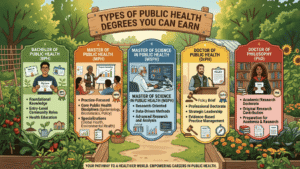
When people talk about a public health degree, they often mean just one thing. But in reality, there are several different types of degrees you can earn in this field. Each one has a different focus, takes a different amount of time, and leads to different career opportunities.
The first option is an associate degree in public health. This is a two-year program usually offered at community colleges. It gives you a basic introduction to public health concepts and can help you land entry-level jobs or transfer to a four-year university. It is a good starting point if you are just exploring the field or working with a tight budget.
Next is the bachelor’s degree in public health. This is a four-year undergraduate program. It goes much deeper into topics like epidemiology, health behavior, environmental health, and health policy. A public health bachelor degree is the most common starting point for people who want to build a serious career in the field. It qualifies you for a wide range of jobs and also prepares you for graduate school.
Then there is the master’s degree in public health, often called an MPH. This is a graduate-level program that usually takes one to two years to complete after your bachelor’s degree. It is one of the most popular advanced degrees in the field. A master’s degree of public health allows you to specialize in areas like epidemiology, global health, health management, or environmental health. Many leadership and research positions require this degree.
Above the master’s level, you have the doctor of public health degree, known as the DrPH. This is for people who want to lead large public health programs or conduct advanced research. It typically takes three to five years and is the highest professional degree in the field.
There is also the PhD in public health, which focuses more on academic research and teaching. If you want to work at a university or conduct original scientific research, a PhD might be the right path. Each of these degrees can also be completed online, which makes them accessible to working adults and people in different locations. No matter which level you choose, a public health degree gives you tools to make a lasting impact.
Bachelor’s Degree in Public Health — What to Expect
A bachelor’s degree in public health is a four-year undergraduate program that gives you a strong foundation in how communities stay healthy and what happens when they do not. It is one of the most flexible and rewarding degrees you can earn, and it opens doors to a wide variety of careers right after graduation.
During your first two years, you will take general education courses along with introductory public health classes. You will learn the basics of biology, statistics, social sciences, and health behavior. These early courses help you understand how the human body works, how societies are organized, and how both of these things affect health outcomes.
In your third and fourth years, things get more specialized. You will dive into courses like epidemiology, which is the study of how diseases spread through populations. You will also study environmental health, health policy, global health, and community health education. Many programs also require you to complete an internship or fieldwork experience, which gives you real-world practice before you graduate.
A public health bachelor degree also teaches you skills that employers love. You will learn how to collect and analyze data, how to design health education programs, how to communicate health information clearly, and how to work with diverse communities. These are practical skills that apply across many industries.
One of the biggest advantages of this degree is its versatility. With a bachelor’s in public health degree, you can work in hospitals, nonprofits, schools, government agencies, or even corporate wellness programs. You are not limited to one type of employer or one type of work.
Jobs with a bachelor degree in public health include health educator, community health worker, public health analyst, and health program coordinator. If you decide you want to go further, a bachelor’s degree also sets you up perfectly for a master’s degree in public health. So this degree is both a great career launcher and a smart stepping stone to advanced education.
Associate Degree in Public Health — Is It Worth It?

An associate degree in public health is a two-year program that introduces you to the basics of community health, disease prevention, and health promotion. It is typically offered at community colleges and is one of the most affordable ways to get started in the public health field.
So is it worth it? The honest answer is — it depends on your goals. If you are just starting out and want to test the waters before committing to a four-year program, an associate degree is a smart move. It gives you foundational knowledge without a huge investment of time or money. You will take courses in health education, basic sciences, communication, and community health. By the end, you will have a solid understanding of what public health is and how it works.
An associate degree can also lead to entry-level jobs. Roles like community health worker, health educator assistant, or medical administrative assistant are often open to graduates with a two-year degree. These positions let you gain real work experience while you decide whether you want to continue your education.
However, it is important to be realistic. The job market for public health professionals strongly favors candidates with at least a bachelor’s in public health degree. Many positions — especially those with higher salaries and more responsibility — require a four-year degree or more. So while an associate degree opens some doors, it does not open all of them.
The best use of an associate degree in public health is often as a transfer pathway. Many community colleges have agreements with four-year universities that allow associate degree graduates to transfer directly into a bachelor’s program with their credits intact. In terms of public health degree jobs, an associate degree is more of a starting block than a finish line. If you plan to keep studying and eventually earn a bachelor’s or master’s degree, it is absolutely worth it.
Master’s Degree in Public Health — A Complete Overview
A master’s degree in public health, commonly known as an MPH, is one of the most respected and in-demand graduate degrees in the healthcare and policy world. It is designed for people who already have a bachelor’s degree and want to take their public health knowledge to a much deeper level. Whether you want to lead health programs, conduct research, or influence policy, a master’s degree in public health gives you the advanced skills to do it.
Most MPH programs take one to two years to complete. During that time, you will study a core set of subjects that every public health professional needs to know. These include biostatistics, epidemiology, health policy and management, social and behavioral sciences, and environmental health. These five areas are considered the foundation of public health education and are covered in almost every accredited MPH program in the country.
Beyond the core courses, you will also choose a concentration or specialization. Common options include global health, maternal and child health, health education and promotion, health informatics, nutrition, and occupational health. Your specialization lets you go deep into the area that interests you most and makes you more competitive for specific types of jobs.
One of the most valuable parts of an MPH program is the practicum or capstone experience. This is a hands-on project where you apply everything you have learned to a real public health problem. Some students work with local health departments, nonprofits, or hospitals. Others conduct original research. This experience is a huge advantage when you enter the job market because it shows employers you can do the work, not just talk about it.
A master’s degree of public health also dramatically expands your salary potential. People with an MPH earn significantly more than those with just a bachelor’s degree. Leadership positions in health departments, hospitals, and international organizations almost always prefer or require a master’s level education.
The degree is also widely respected across different sectors. Whether you want to work in government, academia, private industry, or a nonprofit, an MPH signals that you are serious about public health and have the training to back it up. It is one of the best investments you can make in your public health career.
Doctor of Public Health Degree — The Highest Level

The doctor of public health degree, known as the DrPH, is the highest professional degree you can earn in the field of public health. It is designed for experienced public health professionals who want to move into senior leadership roles, shape major health policies, or lead large-scale public health programs. If you are serious about reaching the top of this field, the DrPH is the degree that gets you there.
It is important to understand the difference between a DrPH and a PhD in public health. A PhD is focused on academic research and is best for people who want to become university professors or conduct original scientific studies. A doctorate degree in public health, on the other hand, is a practice-focused degree. It trains you to apply advanced knowledge to real-world public health challenges. Think of the DrPH as preparing you to lead, and the PhD as preparing you to discover.
Most DrPH programs take three to five years to complete and require you to already have a master’s degree in public health or a related field. The coursework is intense and covers advanced topics like health systems leadership, public health law, advanced epidemiology, organizational management, and global health strategy. You will also complete a dissertation or doctoral project that demonstrates your ability to solve a significant public health problem.
The careers available to DrPH graduates are at the highest levels of the field. Many graduates go on to become directors of public health departments, senior policy advisors, chief health officers, or leaders of major global health organizations. Some work with agencies like the CDC, WHO, or large hospital systems. Others move into academia and teach the next generation of public health professionals.
The salary for someone with a doctorate degree in public health reflects their level of expertise and responsibility. Senior public health leaders with a DrPH can earn well above six figures, especially in government or large healthcare organizations. If you want to lead, influence, and shape the future of public health on a large scale, there is no better credential to have.
Online Public Health Degree — Study From Anywhere

An online public health degree gives you the same education as a traditional on-campus program — but with the flexibility to study from wherever you are. Whether you are a working professional, a parent, or someone who simply does not live near a major university, an online degree in public health removes the barriers that might otherwise stop you from advancing your education.
Online public health programs are offered at every level. You can earn an associate degree, a bachelor’s degree, a master’s degree, or even a doctorate degree in public health completely online. The quality of these programs has improved dramatically over the past decade. Many of the top universities in the country now offer fully accredited online public health degrees that carry the same weight as their in-person equivalents.
One of the biggest advantages of studying online is flexibility. Most programs are designed for working adults, which means you can take classes in the evenings or on weekends. You set your own pace to a large degree, and you do not have to quit your job or relocate to earn your degree. This makes an online public health degree a practical choice for people who have responsibilities outside of school.
The coursework in an online program covers the same core topics you would find in a campus-based program. You will study epidemiology, health policy, biostatistics, environmental health, and social determinants of health. Many programs also include virtual group projects, live video discussions, and real-world practicum experiences that you complete in your local community.
Accreditation is something you should always check when considering an online degree in public health. Look for programs accredited by the Council on Education for Public Health, known as CEPH. Public health degree online programs are offered by well-known institutions across the country. Whether you are looking for a public health bachelor degree online or a fully remote MPH, there are strong options available at different price points. Studying online does not mean settling for less. It means getting a great education on your own terms.

An online master of public health degree program gives working professionals and busy adults the chance to earn one of the most valuable credentials in healthcare without stepping foot on a campus. These programs have grown rapidly in recent years, and today some of the best MPH programs in the country are available entirely online.
The structure of online master degree public health programs varies by school, but most follow a similar format. You will complete core coursework in the five foundational areas of public health — biostatistics, epidemiology, health policy and management, social and behavioral sciences, and environmental health sciences. After finishing the core, you will choose a concentration that matches your career goals.
What makes online MPH programs especially appealing is the ability to keep working while you study. Most programs are built around asynchronous learning, meaning you watch lectures and complete assignments on your own schedule. Some programs also include synchronous sessions — live video classes where you interact with professors and classmates in real time. This blend of flexibility and connection keeps the learning experience engaging without demanding that you rearrange your entire life.
Online master’s degree in public health programs typically take two years to complete, though some accelerated options can be finished in twelve to eighteen months. Part-time tracks are also available for students who need to spread the coursework over three or four years. This variety makes it easier for people at different life stages to find a program that fits.
The cost of an online master of public health degree varies widely. Public universities often offer lower tuition rates, especially for in-state students. When comparing programs, look at accreditation, faculty experience, specialization options, and career placement rates. Public health master degree programs online are offered by many highly ranked universities. A good online MPH should not just give you a diploma — it should open real doors in the public health job market.
Online Bachelor’s Degree in Public Health
An online bachelor’s degree in public health is a four-year undergraduate program that you can complete entirely from home. It is a great option for students who want the full benefits of a public health education but need the flexibility that only an online format can provide. Whether you are a recent high school graduate, a working adult, or someone returning to school after a break, this degree can fit your life.
The curriculum for an online public health bachelor’s degree covers all the same ground as an on-campus program. You will take courses in biology, statistics, health behavior, environmental health, epidemiology, and health policy. You will also study communication and leadership, which are critical skills for anyone who wants to work in the public health field. Many programs include an internship or practicum component that you complete locally, giving you hands-on experience even while studying online.
One of the strongest arguments for earning a public health bachelor degree online is cost savings. Online students often save money on housing, transportation, and campus fees. Many schools also offer financial aid and scholarships specifically for online learners. Combined with lower overall tuition at many public universities, this can make an online degree significantly more affordable than a traditional campus program.
Employers generally view online and on-campus degrees equally, as long as the program is properly accredited. Always check that any online bachelor’s degree in public health you consider is accredited by a recognized body. CEPH accreditation is the gold standard for public health programs, but regional accreditation of the university itself also matters.
Jobs with a public health bachelor’s degree are available across many sectors. Graduates work as health educators, community outreach coordinators, public health analysts, and program administrators. An online public health bachelor’s degree is also a strong foundation for graduate school. If you plan to eventually earn a master’s degree in public health, finishing your bachelor’s degree online is a practical and smart first step that keeps your options wide open.
Public Health Degree Programs — How to Pick the Right One

Choosing the right public health degree program is one of the most important decisions you will make in your academic journey. With hundreds of programs available across the country — on campus and online — it can feel overwhelming. But if you know what to look for, the decision becomes much easier.
The first thing to check is accreditation. Always look for programs accredited by the Council on Education for Public Health, known as CEPH. This is the gold standard for public health education. A CEPH-accredited program meets strict quality standards and is recognized by employers, government agencies, and graduate schools. If a program is not accredited, your degree may not carry the weight you need in the job market.
Next, think about your career goals. Different public health degree programs have different strengths. Some schools are known for their global health programs. Others excel in epidemiology, health policy, or environmental health. Before you apply anywhere, get clear on what you want to do after graduation. Then look for programs that have strong faculty, research opportunities, and alumni networks in that specific area.
Location matters too — even for online programs. Some states have better job markets for public health professionals than others. If you plan to stay in a specific region after graduation, it makes sense to choose a program with strong ties to employers and health agencies in that area. Local connections can lead directly to internships and job offers.
Cost is another major factor. Public health degree programs vary widely in price. Public universities typically offer lower tuition, especially for in-state students. Private schools may cost more but sometimes offer better networking opportunities and career support. Always calculate the total cost of the program, including fees and any required travel, before committing.
Finally, talk to current students and alumni if you can. They will give you an honest picture of what the program is really like — the workload, the professors, the job support, and the overall experience. Choosing the right public health degree program is about finding the best fit for your goals, your budget, and your life.
Is a Public Health Degree Worth It?
This is one of the most common questions people ask before enrolling, and it deserves a direct and honest answer. Yes — for most people, a public health degree is absolutely worth it. But like any major investment, the value depends on how you use it and what you want out of your career.
Let’s start with the job market. Public health is a growing field. The U.S. Bureau of Labor Statistics projects strong growth in health-related occupations over the next decade. Events like the COVID-19 pandemic made it crystal clear that the world needs more trained public health professionals. Governments, hospitals, nonprofits, and private companies are all hiring people with public health skills. That kind of demand translates into real job security.
Then there is the salary. Public health degree salary varies depending on your level of education and the specific role you take. Entry-level jobs with a bachelor’s degree can start in the $40,000 to $55,000 range. With a master’s degree in public health, that number climbs significantly. Senior roles in health administration, epidemiology, and health policy can pay well into six figures. The more education and experience you gain, the higher your earning potential goes.
Beyond money, there is the question of meaning. Public health work genuinely changes lives. You might help reduce infant mortality rates in a low-income neighborhood, design a smoking cessation program that helps thousands of people quit, or lead the response to a disease outbreak. That kind of impact is hard to put a price on.
Is a public health degree worth it? For people who are passionate about health, community, and making a real difference — the answer is a clear and confident yes. If you are committed to a career in health, community development, policy, or research, this degree gives you the credentials and skills to move forward with confidence.
Is Public Health a STEM Degree?

This is a question that comes up often, and the answer might surprise you. Yes — public health is generally considered a STEM degree. STEM stands for Science, Technology, Engineering, and Mathematics, and public health checks several of those boxes in a meaningful way.
Public health programs are heavily grounded in science. You study biology, microbiology, and the life sciences as part of your core curriculum. You learn how diseases develop, how the immune system works, and how environmental factors affect human health. These are all scientific disciplines that require rigorous thinking and a strong understanding of how the natural world works.
The mathematics component is also significant. Biostatistics is one of the five core areas of public health education. You will work with data, analyze health trends, interpret research studies, and use statistical tools to draw conclusions about population health. This is not light math — it requires real analytical skill and comfort with numbers.
Technology plays a growing role in public health as well. Health informatics, data visualization, geographic information systems, and electronic health records are all tools that modern public health professionals use regularly. As healthcare becomes more data-driven, the tech component of public health is only getting bigger.
The STEM classification matters for practical reasons. International students on F-1 visas may be eligible for an extended Optional Practical Training period if they earn a STEM-designated degree. This gives them more time to work in the United States after graduation, which is a significant benefit.
It is worth noting that not all public health programs are officially STEM-designated, even though the content is clearly scientific. If the STEM classification matters to you — especially for visa or financial aid purposes — check with your specific program to confirm their designation status. In short, public health sits comfortably in the STEM world. It combines science, data, and technology with the human side of health, making it one of the most well-rounded and practical STEM fields you can study.
What Can You Do With a Public Health Degree?

One of the most exciting things about earning a public health degree is the sheer range of things you can do with it. This is not a degree that locks you into one career path. It opens doors across healthcare, government, education, research, international development, and the private sector.
Let’s start with the most common question — what can you do with a public health degree right after graduation? With a bachelor’s in public health degree, you can work as a health educator, community health worker, public health analyst, health program coordinator, or outreach specialist. These roles put you in direct contact with communities and give you the chance to make a real difference from day one.
If you go on to earn a master’s degree in public health, the options expand significantly. You become eligible for more advanced roles like epidemiologist, health policy analyst, public health program manager, biostatistician, or environmental health specialist. These positions come with more responsibility and higher salaries, and they often involve leading teams or managing large public health initiatives.
With a doctorate degree in public health, you can move into the highest levels of the field. Senior leadership roles at organizations like the CDC, WHO, or major hospital systems are within reach. You can also move into academia as a professor or researcher, shaping the next generation of public health professionals.
What can you do with a degree in public health beyond traditional health roles? Quite a lot, actually. Public health skills are valued in corporate wellness departments, insurance companies, consulting firms, and technology companies building health apps. If you have strong data skills, you can work as a health data analyst. If you love communication, you can work in health journalism or public relations for healthcare organizations.
The international opportunities are also worth mentioning. Global health is one of the fastest-growing areas in public health. Organizations like UNICEF, the Gates Foundation, and Doctors Without Borders hire public health professionals to work on health challenges in developing countries. What to do with a public health degree ultimately comes down to your interests and goals. The field is wide, the demand is strong, and the work is meaningful.

A public health degree opens the door to a wide variety of careers, and the best part is that you get to choose the direction that excites you most. Whether you love working directly with communities, digging into data, shaping policy, or exploring global health challenges, there is a career path in public health that fits.
One of the most well-known public health degree careers is epidemiology. Epidemiologists study how diseases spread through populations and work to control outbreaks before they become crises. They collect data, identify patterns, and develop strategies to protect community health. This role became one of the most high-profile public health careers during the COVID-19 pandemic, and demand for epidemiologists has stayed strong ever since.
Health education and promotion is another major career area. Health educators design programs that teach people how to make healthier choices. They work in schools, hospitals, community centers, and government agencies. They create materials, run workshops, and connect people with resources that improve their health and wellbeing.
Environmental health is a growing field within public health careers. Environmental health specialists investigate how things like air quality, water contamination, and toxic chemicals affect human health. They work with government agencies, businesses, and communities to identify hazards and reduce exposure to harmful substances.
Health policy and management is the right path if you are interested in the business and government side of healthcare. Policy analysts and health administrators work to improve how healthcare systems are organized and funded. They develop strategies that make healthcare more accessible, efficient, and fair.
Biostatistics is a career for people who love numbers and data. Biostatisticians analyze health data to help researchers and policymakers understand trends and make informed decisions. This is one of the highest-paying areas within public health degree careers, and the demand for skilled data analysts in healthcare continues to grow.
Global health is for people who want to work beyond their own borders. Global health professionals address health challenges in developing countries, including infectious diseases, malnutrition, maternal health, and access to clean water. No matter which direction you choose, public health degree careers are united by one thing — the goal of making life better for as many people as possible.
Jobs With a Public Health Bachelor’s Degree
A public health bachelor’s degree is a strong foundation that qualifies you for a wide range of meaningful and well-paying jobs. Many people assume you need a master’s degree to work in public health, but that is not true. There are plenty of excellent career opportunities available right after earning your four-year degree.
One of the most common jobs with a public health bachelor’s degree is health educator. Health educators design and deliver programs that help people understand health risks and make better choices. They work in schools, hospitals, community health centers, and government agencies. They create educational materials, run workshops, and connect individuals with health resources. It is a hands-on role that puts you in direct contact with the communities you serve.
Community health worker is another popular entry-level role. Community health workers act as a bridge between healthcare providers and the communities they serve. They help people navigate the healthcare system, connect them with social services, and provide basic health education. This role is especially important in underserved communities where access to healthcare is limited.
A public health analyst is a great fit for graduates who enjoy working with data. In this role, you collect and analyze health data to identify trends and help organizations make better decisions. You might work for a government health department, a hospital, or a research organization. Strong analytical and communication skills are key in this position.
Health program coordinator is another solid option. In this role, you help plan, implement, and evaluate public health programs. You might manage budgets, coordinate with community partners, and track program outcomes. It is a role that requires strong organizational skills and the ability to work with many different people at once.
Other jobs with a bachelor degree in public health include public health inspector, health communications specialist, social services coordinator, and patient advocate. Public health bachelor degree jobs also serve as excellent stepping stones. Many people start in these entry-level roles, gain experience, and then go back to school for a master’s degree in public health to advance their careers.
Jobs With a Public Health Master’s Degree
Earning a master’s degree in public health significantly expands your career options and your earning potential. With an MPH in hand, you move beyond entry-level roles and become eligible for positions that involve leadership, research, and policy. These are the jobs that shape how communities and systems approach health on a large scale.
One of the top jobs with a public health master’s degree is epidemiologist. Epidemiologists investigate the causes and patterns of disease in populations. They design studies, collect data, and analyze results to understand how health threats develop and spread. Many epidemiologists work for government agencies like the CDC or state health departments, though hospitals and research universities also hire them regularly.
Health policy analyst is another high-impact role for MPH graduates. In this position, you study existing health policies, identify gaps and problems, and develop recommendations for improvement. You might work for a government agency, a think tank, a hospital system, or a nonprofit. Strong research and writing skills are essential, and the work directly influences how healthcare is delivered and funded.
Public health program manager is a leadership role that puts you in charge of designing, running, and evaluating health programs. You manage teams, oversee budgets, and make sure programs are achieving their goals. This role exists in health departments, hospitals, international organizations, and community health centers.
Biostatistician is one of the highest-paying jobs with a public health master’s degree. Biostatisticians use advanced statistical methods to analyze health data and support medical research. They work closely with researchers, doctors, and policymakers to make sense of complex data sets. A strong background in statistics and data analysis is essential for this role.
Other strong options include environmental health specialist, health informatics analyst, global health consultant, and maternal and child health coordinator. Master’s degree in public health jobs span a wide range of sectors and specializations. Jobs with a public health master’s degree also tend to come with better benefits, more responsibility, and clearer paths to advancement than entry-level positions.
Highest Paying Jobs With a Public Health Degree
Public health is not just a meaningful field — it is also a financially rewarding one, especially as you advance your education and gain experience. The highest paying jobs with a public health degree combine specialized expertise, leadership responsibility, and strong demand from employers across healthcare, government, and the private sector.
At the top of the salary ladder is the health services manager or healthcare administrator. These professionals oversee the operations of hospitals, clinics, and other healthcare facilities. They manage budgets, supervise staff, develop policies, and make sure the organization runs efficiently. Experienced healthcare administrators can earn well over $100,000 per year, with top earners in large hospital systems making significantly more.
Epidemiologists with advanced degrees and several years of experience also earn strong salaries. Senior epidemiologists working for federal agencies like the CDC or for large research institutions can earn between $80,000 and $120,000 or more depending on their specialization and location. Those who specialize in infectious disease or bioterrorism preparedness are especially well compensated.
Biostatisticians are among the highest paid professionals in the public health world. Their expertise in data analysis is in high demand not just in public health but also in pharmaceutical companies, insurance firms, and technology companies. Experienced biostatisticians can earn between $90,000 and $130,000 or more annually.
Health policy directors and senior policy advisors also command high salaries. These roles involve developing and advocating for health policies at the state or federal level. They require a deep understanding of health systems, law, and politics, and they come with significant influence and responsibility.
Environmental health directors, global health directors, and chief public health officers round out the list of highest paying jobs with a public health degree. These senior leadership positions typically require a master’s degree or doctorate in public health, along with many years of relevant experience. What jobs can you get with a public health degree that pay well at the entry level? Roles like public health analyst and health program coordinator provide a solid starting salary and a clear path toward higher-paying positions.
Public Health Degree Salary — What to Expect
Understanding the salary potential of a public health degree is important before you commit to the program. The good news is that public health professionals are well compensated across all levels of education and experience. While salaries vary depending on your role, location, and specialization, the overall picture is positive and continues to improve as the demand for public health expertise grows.
At the entry level, graduates with a bachelor’s in public health degree typically earn between $40,000 and $55,000 per year. Roles like health educator, community health worker, and public health program assistant fall into this range. While these salaries may seem modest at first, they come with real opportunities for advancement as you gain experience and additional credentials.
With a master’s degree in public health, your earning potential increases significantly. The average salary for MPH graduates ranges from $60,000 to $85,000 per year, depending on the role and the employer. Epidemiologists, health policy analysts, and program managers with an MPH tend to land on the higher end of that range. In high-cost cities or specialized roles, salaries can go even higher.
Public health degree salary also depends heavily on the sector you work in. Government jobs often offer strong benefits packages and job stability, even if the base salary is slightly lower than in the private sector. Private companies — especially pharmaceutical firms, health tech companies, and insurance organizations — tend to pay more but may offer less job security.
Location plays a major role in salary as well. Public health professionals working in cities like New York, San Francisco, Boston, and Washington D.C. typically earn more than those in rural areas, simply because the cost of living and the concentration of employers are higher in those markets.
Public health degree jobs salary also grows with experience. A public health professional with ten or fifteen years of experience can expect to earn significantly more than someone just starting out, even if they hold the same job title. Continuing education, professional certifications, and leadership experience all contribute to salary growth over time. The overall trajectory for public health salaries is upward.
Public Health Master’s Degree Salary
If you are thinking about earning a master’s degree in public health and wondering what kind of salary you can expect, the answer is encouraging. An MPH is one of the most financially rewarding graduate degrees you can earn in the health field, and the return on investment is strong for most graduates.
The average salary for someone with a public health master’s degree falls between $60,000 and $90,000 per year, depending on the specific role, the employer, and the location. However, many experienced MPH graduates earn well above that range, especially in senior or specialized positions.
Let’s break it down by role. Epidemiologists with an MPH earn an average of $75,000 to $95,000 per year. Health policy analysts typically earn between $65,000 and $85,000. Public health program managers can expect salaries in the $70,000 to $90,000 range. Biostatisticians with a master’s degree are among the highest earners, often pulling in $85,000 to $120,000 or more depending on their industry and experience level.
Master of public health MPH degree salaries also vary significantly by specialization. Graduates who specialize in health informatics, biostatistics, or health administration tend to earn more than those who focus on health education or community health. This is because data-heavy and management-focused roles are in high demand across both public and private sectors.
Employer type also affects salary. Federal government positions, such as those at the CDC or NIH, offer competitive salaries along with excellent benefits and job security. State and local health departments may pay slightly less but offer stability and meaningful work. Private sector employers — including pharmaceutical companies, health tech firms, and consulting agencies — often offer the highest base salaries for MPH graduates.
Jobs with public health master’s degree in high-cost cities like New York, Los Angeles, and Washington D.C. typically come with higher salaries to match the cost of living. Overall, a public health master’s degree salary reflects the value that employers place on advanced public health training. The degree pays for itself relatively quickly for most graduates, making it one of the smartest educational investments in the healthcare field.
Public Health Nurse Degree — A Specialized Path
A public health nurse degree combines the clinical skills of nursing with the community-focused approach of public health. It is a specialized and deeply rewarding career path for people who want to do more than treat patients one at a time. Public health nurses work with entire communities to prevent disease, promote healthy behaviors, and connect people with the care they need.
To become a public health nurse, you typically need at least a bachelor of science in nursing, known as a BSN. However, many public health nursing roles also require or strongly prefer candidates who have completed additional coursework in public health. Some nurses earn a dual degree or a certificate in public health alongside their nursing degree. Others go on to earn a master’s degree in public health to move into leadership and policy roles within the nursing field.
Public health nurses work in a wide variety of settings. You might find them in county health departments, school systems, community health clinics, home health agencies, or nonprofit organizations. They conduct health screenings, run immunization clinics, visit patients at home, educate communities about disease prevention, and advocate for health policy changes that benefit vulnerable populations.
One of the most important aspects of public health nursing is the focus on health equity. Public health nurses often work with underserved communities — people who face barriers to healthcare because of poverty, language, immigration status, or geography. Their work helps close the gap between those who have access to good healthcare and those who do not.
The salary for public health nurses reflects both their nursing credentials and their public health expertise. Entry-level public health nurses typically earn between $55,000 and $70,000 per year. Those with advanced degrees and leadership experience can earn significantly more, especially in urban areas or specialized roles. If you are already a nurse and want to expand your impact, pursuing a public health degree is one of the most powerful moves you can make.
Scholarships for Master’s Degree in Public Health
Paying for a master’s degree in public health is a real concern for many students, but the good news is that there are more funding options available than most people realize. Scholarships, fellowships, grants, and assistantships can significantly reduce the cost of your MPH and make graduate school much more affordable.
One of the best places to start is with your own university. Most schools that offer a master’s degree in public health also offer merit-based scholarships for incoming students. These awards are often based on your academic record, your professional experience, and the strength of your application. Some schools automatically consider all applicants for these scholarships, while others require a separate application. Always ask the admissions office about available funding before you enroll.
Federal funding is another major source of support for MPH students. The Health Resources and Services Administration, known as HRSA, offers several scholarship and loan repayment programs for public health students who commit to working in underserved communities after graduation. The National Health Service Corps is one of the most well-known of these programs and can cover significant tuition costs in exchange for a service commitment.
Professional organizations in the public health field also offer scholarships. The American Public Health Association, the Association of Schools and Programs of Public Health, and various specialty organizations within public health all have funding opportunities for graduate students. These scholarships are often discipline-specific, so a student focusing on epidemiology might find different funding than one specializing in global health.
For students from underrepresented backgrounds, there are dedicated scholarships aimed at increasing diversity in the public health workforce. Organizations like the Robert Wood Johnson Foundation and the CDC have historically supported programs that help minority students earn advanced public health degrees.
Graduate assistantships are another excellent way to fund your master’s degree in public health. Many universities offer teaching or research assistantships that cover tuition and provide a monthly stipend in exchange for working with faculty on research projects or helping teach undergraduate courses. Scholarships for masters degree in public health are out there — you just have to look for them and apply early.
Master’s Degree in Public Health in the UK
The United Kingdom is home to some of the world’s most respected universities, and many of them offer outstanding master’s degree in public health programs. For international students and UK residents alike, earning an MPH in the UK is a prestigious and practical path to a rewarding career in global and domestic public health.
UK master’s programs in public health are typically one year long for full-time students, which is shorter than the standard two-year format in the United States. This condensed timeline means you can enter the workforce sooner and spend less on tuition and living expenses overall. Part-time options are also available at most universities, usually stretching the program over two to three years for students who need to balance work and study.
Some of the top universities for a master’s degree in public health UK include the London School of Hygiene and Tropical Medicine, University College London, the University of Edinburgh, and the University of Manchester. These institutions have strong global reputations, experienced faculty, and excellent connections to health organizations in the UK and internationally.
The curriculum for a UK-based MPH covers similar ground to programs in the United States. You will study epidemiology, health policy, biostatistics, global health, and health promotion. Many programs also offer specialized pathways in areas like infectious disease, health economics, or environmental health. The teaching style in UK programs tends to be more seminar-based and research-focused than in American programs, which suits students who enjoy independent study and critical analysis.
Tuition for a master’s degree in public health in the UK varies by university. UK and EU students generally pay lower fees than international students. However, many universities offer scholarships specifically for international applicants, and the UK government’s Chevening Scholarship program supports outstanding students from around the world who want to study in the UK. For students who want a globally recognized degree with a strong research foundation and an international network, a master’s degree in public health UK is an excellent choice.
Public Health Degree in New York and NYC
New York City is one of the best places in the world to earn and use a public health degree. As the most populous city in the United States and a global hub for healthcare, research, and policy, New York offers unmatched opportunities for public health students and professionals at every level.
Several top universities in New York offer strong public health degree programs. Columbia University’s Mailman School of Public Health is one of the most prestigious public health schools in the country. It offers bachelor’s, master’s, and doctoral programs across a wide range of specializations, including epidemiology, environmental health, population and family health, and health policy and management. The school has deep ties to major health organizations in the city and around the world.
New York University also offers excellent public health programs through its School of Global Public Health. NYU’s location in Manhattan puts students in the heart of one of the most diverse and health-challenged urban environments in the world, making it an incredible living classroom for public health study. The school emphasizes global health perspectives and offers strong connections to international organizations.
CUNY — the City University of New York — is another strong option, particularly for students looking for more affordable public health degree programs in NYC. CUNY’s School of Public Health offers graduate programs with a strong focus on urban health and the health of underserved communities, which are critical issues in a city as large and diverse as New York.
The job market for public health professionals in New York is one of the strongest in the country. The New York City Department of Health and Mental Hygiene is one of the largest local health departments in the world and is a major employer of public health graduates. Public health degree New York programs also benefit from the city’s extraordinary diversity. Working and studying in a city where over 800 languages are spoken gives you exposure to health challenges and cultural contexts that you simply cannot find anywhere else.
USC Public Health Degree — What Makes It Stand Out
The University of Southern California, commonly known as USC, is home to one of the most respected public health programs on the West Coast. The USC Keck School of Medicine houses the Department of Population and Public Health Sciences, which offers a range of degree options for students interested in pursuing a public health career at any level.
USC’s public health programs stand out for several reasons. First, the university’s location in Los Angeles gives students access to one of the most diverse and complex urban health environments in the country. Los Angeles is home to millions of people from hundreds of different cultural backgrounds, and the health challenges of this city mirror many of the most pressing public health issues facing the United States and the world. Studying public health at USC means learning in a real-world laboratory that is as challenging as it is rich with opportunity.
USC offers both undergraduate and graduate public health programs. At the graduate level, the Master of Public Health program covers the core areas of public health education while offering concentrations in areas like health communication, global health, and community health promotion. The program is designed to be practical and career-focused, with strong connections to health organizations and employers throughout Southern California.
The faculty at USC’s public health programs bring a wide range of expertise to the classroom. Many are active researchers who are working on real public health problems, from air pollution in Los Angeles neighborhoods to health disparities in immigrant communities. Students benefit from working alongside faculty who are not just teaching theory but actively solving the health challenges of today.
USC also has a strong alumni network that spans the globe. Graduates of USC public health degree programs work in government agencies, international health organizations, hospitals, research institutions, and nonprofits around the world. The USC name carries weight in the public health community, and the connections you make during your time there can open doors throughout your career. For students on the West Coast who want a prestigious, practice-focused public health education in a dynamic urban environment, the USC public health degree is one of the strongest options available.
TAMU Public Health Degree Plan — A Closer Look
Texas A&M University, widely known as TAMU, offers one of the most comprehensive and well-structured public health programs in the state of Texas. The School of Public Health at Texas A&M is accredited by the Council on Education for Public Health, which means its programs meet the highest standards in public health education and are recognized by employers and graduate schools nationwide.
The TAMU public health degree plan is designed to give students a strong foundation in all the core areas of public health while also allowing them to specialize in the areas that interest them most. Whether you are pursuing a bachelor’s degree, a master’s degree, or a doctoral degree in public health, Texas A&M has a structured and well-supported path to help you get there.
At the undergraduate level, the public health degree plan TAMU offers covers courses in epidemiology, biostatistics, environmental health, health policy, and social and behavioral health. Students also complete a practicum experience that gives them hands-on exposure to real public health work before they graduate. This practical component is one of the things that sets the TAMU program apart from purely classroom-based programs at other schools.
The public health TAMU degree plan also includes clear requirements for general education, major-specific coursework, and elective credits. This transparency makes it easier for students to plan their academic path from the very beginning and avoid surprises along the way. Academic advisors at the School of Public Health are known for being accessible and supportive, which makes the planning process much smoother for students.
At the graduate level, Texas A&M offers an MPH program with several concentration options, including health policy and management, epidemiology, environmental and occupational health, and community health. The tamu public health degree plan also connects students to a strong network of public health professionals across Texas and beyond. Texas A&M has close ties to health departments, hospitals, and research institutions throughout the state, which creates excellent internship and job placement opportunities for graduates.
UH Public Health Degree Plan Overview
The University of Houston, commonly referred to as UH, offers a growing and increasingly respected public health program that serves students across Texas and beyond. The uh public health degree plan is built around the same core competencies that form the backbone of accredited public health education nationwide, making it a solid and credible option for students who want to enter the field without leaving Texas.
UH’s public health program is housed within the College of Liberal Arts and Social Sciences, which reflects the interdisciplinary nature of public health as a field. Students in the program draw on knowledge from sociology, biology, political science, and health sciences to build a well-rounded understanding of how health works at the community and population level.
The undergraduate public health degree plan at UH covers all the essential areas you would expect from a quality program. Courses in epidemiology, health behavior, environmental health, health policy, and research methods give students the academic foundation they need to enter the workforce or continue on to graduate school. The program also emphasizes cultural competence and health equity, which are critical skills for working in a diverse city like Houston.
Houston itself is one of the most medically significant cities in the United States. It is home to the Texas Medical Center, the largest medical complex in the world, which includes dozens of hospitals, research institutions, and health organizations. UH students have access to internship and networking opportunities within this massive healthcare ecosystem, giving them a significant advantage when it comes to launching their public health careers.
The uh public health degree plan also serves as an excellent launching pad for graduate school. Students who complete their bachelor’s degree at UH are well prepared to apply to MPH programs at Texas A&M, UT Health, or other graduate institutions. For students in the Houston area who want an affordable, high-quality public health education with access to world-class healthcare resources, the UH public health degree plan is a smart and practical choice.
Master of Public Health MPH Degree Salaries by Specialization
One of the most important things to understand about an MPH degree is that your salary after graduation depends heavily on your chosen specialization. Not all public health careers pay the same, and the concentration you select during your master’s program can have a significant impact on your long-term earning potential.
Biostatistics is consistently one of the highest-paying specializations within the MPH. Biostatisticians analyze complex health data and support medical research across a wide range of industries. Because their skills are valuable not just in public health but also in pharmaceuticals, insurance, and technology, biostatisticians enjoy some of the strongest salaries in the field. Experienced biostatisticians with an MPH can earn between $90,000 and $130,000 or more per year.
Health informatics is another high-earning specialization. As healthcare becomes increasingly data-driven, professionals who understand both public health and health information technology are in extremely high demand. Health informatics specialists manage electronic health records, analyze patient data, and help organizations use technology to improve health outcomes. Salaries in this area typically range from $75,000 to $110,000 depending on experience and employer.3606265631
Epidemiology is one of the most well-known MPH specializations, and it pays well too. Epidemiologists with a master’s degree earn an average of $75,000 to $95,000 per year. Those who specialize in infectious disease, chronic disease, or environmental epidemiology and work for federal agencies like the CDC often earn on the higher end of that range.
Health policy and management is the right specialization if you want to move into leadership or administrative roles. MPH graduates in this area work as health administrators, policy analysts, and program directors. Salaries range from $70,000 to $100,000 or more, with top earners in senior leadership positions at large hospitals or government agencies making well above that.
Environmental health is a growing specialization with strong salary potential. Master of public health MPH degree salaries in environmental health typically fall between $65,000 and $90,000 per year. Global health is a passion-driven specialization that can also be financially rewarding, especially for those who reach senior levels. Understanding master degree in public health jobs and their associated salaries by specialization helps you make a more informed decision about which concentration to pursue.
Graduate Degree in Public Health — Is It Right for You?
A graduate degree in public health is a significant investment of time, money, and energy. Before you commit, it is worth taking an honest look at whether it is the right move for your specific situation and goals. For many people, the answer is a clear yes. For others, it makes more sense to gain work experience first or explore other options.
The first question to ask yourself is where you want to go in your career. If you are aiming for leadership roles, research positions, or specialized jobs in areas like epidemiology, biostatistics, or health policy, a graduate degree in public health is often a requirement, not just a preference. Employers in these areas expect candidates to have advanced training, and without a master’s or doctoral degree, you may find yourself hitting a ceiling in your career progression.18444152311
On the other hand, if you are just starting out and not yet sure what direction you want to take in public health, it might be smarter to work for a few years first. Real-world experience helps you identify what you love and what you are good at. It also makes you a stronger graduate school applicant and helps you choose a specialization that truly fits your interests.
Financial considerations are also important. A masters degree in public health is a real cost, and it is worth calculating your expected return on investment before you enroll. Look at the average salaries for the roles you are targeting and compare them to the cost of the program. In most cases, the numbers work out in your favor, especially if you choose an affordable program or secure scholarships and assistantships.
Masters in public health online degree programs have made graduate education more accessible than ever before. Whether you are in a big city or a rural area, you can now earn a respected graduate degree from a top university without relocating or quitting your job. This flexibility has opened the door for many people who would otherwise not have been able to pursue advanced education.
A graduate degree in public health is right for you if you are serious about advancing in the field, willing to put in the work, and clear on the career outcomes you are working toward. It is one of the most powerful tools available for building a long, meaningful, and well-compensated career in public health.
Online Degree in Public Health — Flexibility Meets Quality
An online degree in public health is one of the most practical and accessible ways to enter or advance in this important field. Whether you are earning your first degree or adding a graduate credential to your resume, online public health programs offer the same quality education as traditional campus programs — with the added benefit of flexibility that fits your life.
The growth of online public health education over the past decade has been remarkable. What started as a limited number of distance learning options has expanded into a rich landscape of fully accredited programs at every degree level. Today, you can earn an associate degree, a bachelor’s degree, a master’s degree, or even a doctorate in public health entirely online from respected universities across the country.
One of the biggest advantages of an online public health degree is the ability to study without uprooting your life. You do not have to move to a new city, quit your job, or put your family on hold to earn your degree. You can take classes in the evenings, on weekends, or during lunch breaks. This kind of flexibility makes higher education possible for people who would otherwise have to put their dreams on hold.
Public health degree online programs are built for engagement and interaction, not just passive video watching. Most programs use a combination of recorded lectures, live video sessions, discussion boards, group projects, and one-on-one meetings with professors. These tools create a real learning community even when students are spread across different states or countries.
Online public health programs also typically include a practicum or field experience component. This means you will get hands-on public health experience in your own community, working with local health departments, nonprofits, or healthcare organizations. This real-world work is a critical part of your education and makes you much more competitive in the job market after graduation.
Masters public health degree online programs are especially popular among working professionals who want to advance their careers without stepping away from their current jobs. The combination of quality education, professional flexibility, and strong career outcomes makes an online degree in public health one of the best educational investments you can make in today’s job market.
Frequently Asked Questions About Public Health Degrees
- How long does it take to earn a public health degree?
The time it takes depends on the level of degree you are pursuing. An associate degree in public health takes about two years. A bachelor’s degree in public health typically takes four years of full-time study. A master’s degree in public health usually takes one to two years after your bachelor’s degree, depending on whether you study full time or part time. A doctorate degree in public health can take anywhere from three to five years beyond your master’s degree. Online programs often offer flexible timelines that allow you to move faster or slower depending on your schedule and personal commitments.
- What is the difference between an MPH and a master’s degree in public health?
These two terms refer to the same degree. MPH stands for Master of Public Health, which is simply the official name of the master’s degree in public health. Both terms are used interchangeably in academic and professional settings. When you see job postings that ask for an MPH or a master’s degree of public health, they are asking for the same credential. The MPH is the most common graduate degree in the public health field and is offered by hundreds of accredited universities across the United States and around the world.
- Can I earn a public health degree online?
Yes, absolutely. Online public health degree programs are widely available at every level, from associate degrees to doctoral programs. Many top universities now offer fully accredited online public health degrees that carry the same weight as their on-campus equivalents. An online public health degree is a great option for working professionals, parents, and anyone who needs flexibility in their schedule. Just make sure the program you choose is accredited by the Council on Education for Public Health to ensure your degree is recognized by employers.
- What jobs can I get with a public health degree?
A public health degree opens the door to a wide range of careers. With a bachelor’s degree, you can work as a health educator, community health worker, public health analyst, or health program coordinator. With a master’s degree in public health, you become eligible for more advanced roles like epidemiologist, health policy analyst, biostatistician, public health program manager, and environmental health specialist. With a doctorate degree in public health, you can move into senior leadership roles at government agencies, international health organizations, hospitals, and universities. Public health degree careers span government, nonprofit, private sector, and international organizations.
- Is a public health degree worth the investment?
For most people who are serious about a career in health, the answer is yes. A public health degree gives you specialized knowledge, practical skills, and professional credentials that employers value highly. The job market for public health professionals is strong and growing, especially after the COVID-19 pandemic highlighted the critical need for trained public health workers. Salaries for public health degree jobs are competitive and grow significantly with experience and advanced education. When you factor in job security, salary potential, and the meaningful nature of the work, a public health degree is a smart and worthwhile investment for the right person.
- How much does a public health degree cost?
The cost of a public health degree varies widely depending on the school, the degree level, and whether you study on campus or online. At the undergraduate level, public universities typically charge between $10,000 and $30,000 per year in tuition, while private universities can charge significantly more. For a master’s degree in public health, total program costs generally range from $20,000 to $70,000 or more depending on the institution. Many students reduce their costs through scholarships, grants, assistantships, and employer tuition reimbursement programs. Online programs often come with lower overall costs because you save on housing and commuting expenses.
- What is the highest paying job with a public health degree?
Some of the highest paying jobs with a public health degree include healthcare administrator, senior epidemiologist, biostatistician, health policy director, and chief public health officer. Healthcare administrators and senior health executives at large hospital systems or government agencies can earn well over $100,000 per year. Biostatisticians are also among the top earners in the field, with experienced professionals earning between $90,000 and $130,000 or more annually. Reaching these salary levels typically requires a master’s degree or doctorate in public health along with several years of relevant experience and strong leadership skills.
- Do I need a master’s degree to work in public health?
No, you do not need a master’s degree to work in public health. A bachelor’s in public health degree qualifies you for many entry-level and mid-level roles, including health educator, community health worker, public health analyst, and program coordinator. However, a master’s degree in public health significantly expands your career options and earning potential. Many advanced roles in research, policy, and leadership require or strongly prefer candidates with an MPH. If you want to reach the higher levels of the field and take on more responsibility and higher pay, earning a master’s degree is a smart and strategic move that most public health professionals eventually pursue.