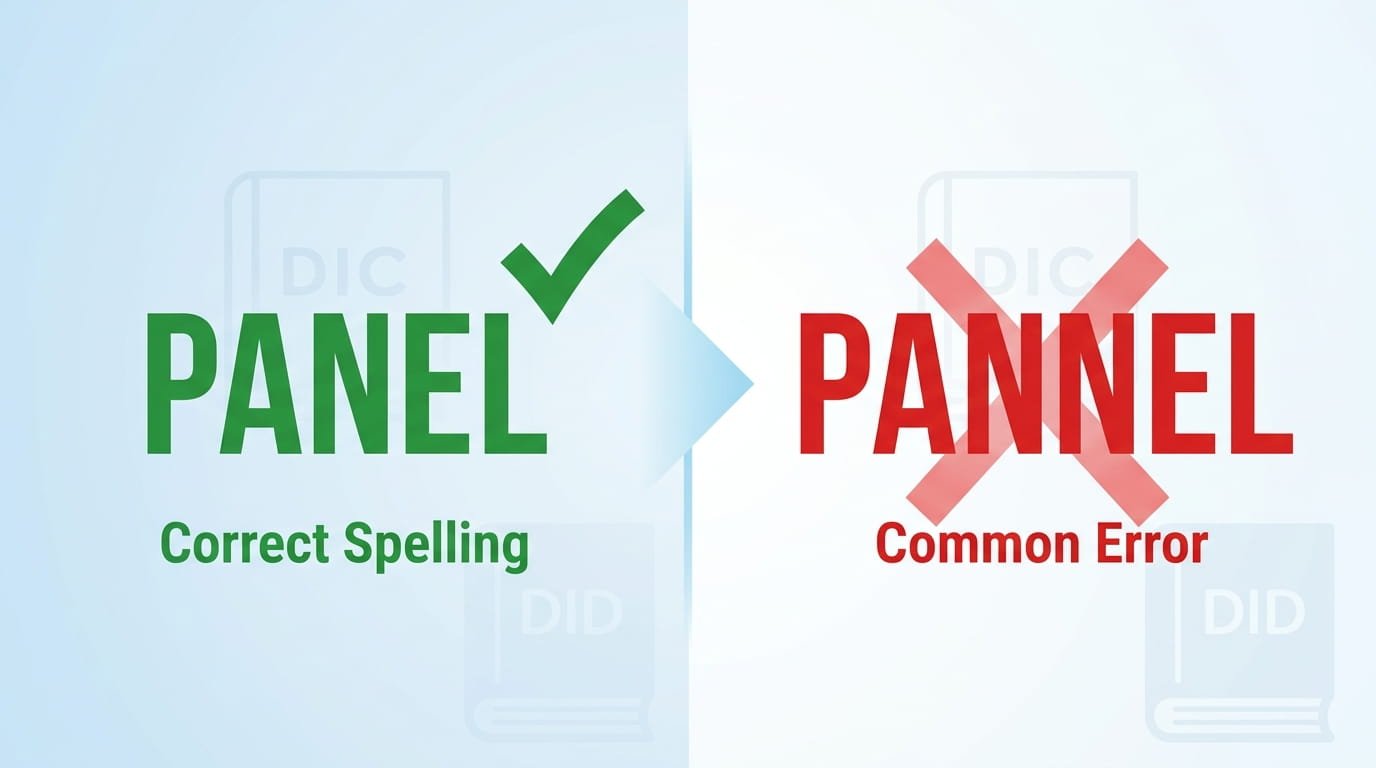
If you have ever paused mid-sentence, unsure whether to type “panel” or “pannel,” you are far from alone. This is one of the most common spelling mix-ups in the English language, and it trips up native speakers and English learners alike. Whether you are writing a business email, a school assignment, a blog post, or a casual social media caption, getting this word right matters more than you might think.
In this comprehensive guide, we will settle the debate once and for all, explore the meaning and origin of the word, look at real-world usage examples, and give you simple memory tricks so you never make this mistake again.
The Quick Answer: Panel vs Pannel
Let’s not keep you waiting. The correct spelling in modern English is “panel” — with a single “n.” The spelling “pannel”, with a double “n,” is considered incorrect in contemporary English and is not recognized as a standard word by major dictionaries.
So whenever you are debating panel vs. pannel, remember this simple rule: one “n” is all you need. If you type “pannel” into a spell-checker, it will almost certainly get flagged as an error, and for good reason — it does not appear as a valid entry in modern dictionaries such as Merriam-Webster, Cambridge, or Oxford.
Why Do People Confuse Panel and Pannel?
Understanding why this mistake happens so often can help you avoid it permanently. There are a few reasons English speakers frequently misspell “panel” as “pannel”:
1. Confusion With Double-Consonant Words
English is full of words that double their consonants, such as “channel,” “tunnel,” “funnel,” and “kennel.” Since “panel” rhymes with many of these words, people naturally assume it follows the same double-consonant pattern. However, “panel” breaks this pattern and uses only a single “n.”
2. Phonetic Spelling Habits
Many spelling errors in English come from writing words the way they sound rather than the way they are actually spelled. Because of how “panel” is pronounced, some writers instinctively add an extra “n,” assuming it strengthens the middle syllable sound. This is a classic example of phonetic misspelling.
3. Historical and Archaic Usage
Interestingly, “pannel” is not a completely made-up word. It has appeared in old or archaic English texts, sometimes referring to a type of rustic saddle, a rough cushion, or even the stomach area of a hawk in falconry contexts. It has also historically been used as an old-fashioned variant spelling of “panel,” and in some very old legal or dialectal records it referred to a list of jurors or a type of small cart used to carry equipment on a march.
Because “pannel” genuinely existed in older or regional English, some people mistakenly assume it is still an acceptable variant today. In modern standard English, however, it is not — it is treated purely as a misspelling of “panel.”
4. Autocorrect and Typing Speed
Fast typing, especially on mobile devices, often leads to accidental double letters. Since “n” and “l” sit close together on a keyboard, and muscle memory from words like “channel” kicks in, “pannel” slips through more often than you’d expect — especially in casual texting or social media posts.
What Does “Panel” Actually Mean?
One reason the correct spelling matters so much is that “panel” is a genuinely versatile word with several distinct meanings depending on context. Let’s break down its most common uses.
1. A Flat or Rectangular Surface Piece
The most literal meaning of “panel” refers to a flat or curved section of material, often rectangular, that forms part of a larger surface. Examples include:
- A wooden panel on a door or wall
- A control panel in a car or aircraft
- A solar panel on a rooftop
- A door panel or ceiling panel in home construction
2. A Group of People
“Panel” is also widely used to describe a select group of individuals brought together for a specific purpose, such as:
- A panel of judges at a competition
- A discussion panel at a conference
- A jury panel in a courtroom
- An expert panel reviewing a proposal
3. A Section in a Comic or Graphic Novel
In visual storytelling, each individual illustrated box or frame is referred to as a panel. A single page of a comic book might contain anywhere from one to a dozen panels, each showing a different moment in the story.
4. A Verb Form
“Panel” can also function as a verb, meaning to cover or decorate a surface with panels. For example: “The carpenter panelled the entire wall with dark oak.”
5. Legal and Technical Uses
In some technical and legal contexts, “panel” refers to a formal list, such as a panel of approved solicitors, a testing panel in medical diagnostics (like a blood panel), or a panel of arbitrators.
As you can see, the word “panel” carries real weight and versatility across everyday language, technical fields, media, and law — which is exactly why using the correct spelling matters so much for clear communication.
Where “Pannel” Comes From (And Why It’s Outdated)
Language historians note that spelling in English was far less standardized centuries ago. Before dictionaries and formal spelling rules became widespread, words often had multiple accepted spellings depending on region, dialect, and personal preference. “Pannel” was one such variant that existed alongside “panel” in older English texts.
However, as English spelling became increasingly standardized — particularly following the widespread adoption of dictionaries in the 18th and 19th centuries — “panel” became the single accepted form, while “pannel” fell out of common use. Today, if you search for “pannel” in any major modern dictionary, you either won’t find it at all, or you’ll be redirected straight to “panel” as the correct entry.
This is an important distinction for writers: just because a word appeared historically does not mean it is acceptable in modern professional or academic writing. Just as we no longer use certain archaic verb forms or outdated grammar structures, “pannel” belongs to the past, not the present.
Panel vs. Pannel: Side-by-Side Comparison
| Feature | Panel | Pannel |
|---|---|---|
| Correct in modern English | ✅ Yes | ❌ No |
| Recognized by major dictionaries | ✅ Yes | ❌ No (or only as archaic/rare) |
| Used in professional writing | ✅ Yes | ❌ No |
| Historical/archaic usage | Also standard historically | Existed in old texts, saddle/dialect terms |
| Number of “n”s | One | Two |
| Recommended for everyday use | ✅ Always | ❌ Never |
How to Use “Panel” Correctly in a Sentence
Seeing the word in real, natural sentences can help cement the correct spelling in your memory. Here are several examples across different contexts:
- “The detective examined a hidden panel in the wall, revealing a secret compartment.”
- “A distinguished panel of judges awarded the top prize to the young inventor.”
- “He carefully installed each wooden panel to ensure a seamless fit for the new fence.”
- “The electrician checked the breaker panel after the lights went out.”
- “She was invited to join a panel discussion on renewable energy.”
- “The solar panel installation was completed ahead of schedule.”
- “The car’s dashboard panel lit up with a warning light.”
- “The comic’s final panel revealed a surprising twist.”
- “The doctor ordered a full blood panel to check her cholesterol levels.”
- “The company hired an outside panel to review its hiring practices.”
Notice how in every single one of these examples, only “panel” fits — “pannel” would be marked incorrect in every case, whether in a novel, a news report, a DIY guide, or a casual conversation.
Common Phrases That Always Use “Panel”
To reinforce the correct usage, here are some extremely common phrases and compound terms that always use the single-“n” spelling:
- Control panel
- Solar panel
- Panel discussion
- Panel interview
- Panel of experts
- Jury panel
- Wall panel
- Wood panel
- Instrument panel
- Panel van
- Panel beater (a term common in British and Australian English for someone who repairs car body panels)
- Panel data (a term used in statistics and economics)
If you memorize just a few of these phrases, you will naturally reinforce the correct spelling every time you use them.
Simple Tricks to Remember the Correct Spelling
If you still find yourself hesitating between panel and pannel, try one of these memory tricks:
Trick 1: Think of “Channel”
While “panel” doesn’t follow the double-consonant pattern of “channel,” you can use this exact contrast as your memory anchor: “Channel has two Ns, but panel only needs one.” Turning the exception into the memory device works surprisingly well.
Trick 2: One Flat Surface, One “N”
Since a panel is often described as a single, flat piece of material, associate the idea of “one flat thing” with “one letter N.” This simple visual association can make the correct spelling stick.
Trick 3: Compare to “Camel”
Both “panel” and “camel” follow a similar rhythm and both use only a single consonant in the middle. If you already spell “camel” correctly without adding an extra “m,” apply that same logic to “panel.”
Trick 4: Trust Your Spell-Checker — But Verify It
Most modern word processors and browsers will automatically underline “pannel” as an error. However, don’t rely on autocorrect alone, especially on mobile devices, where it may not catch every instance, particularly in fast typing or voice-to-text scenarios.
Is “Pannel” Ever Correct?
There are a few very narrow cases where you might legitimately encounter the spelling “pannel,” though these are rare and largely historical or specialized:
- Old or archival texts — Historical documents, especially before the 19th century, may use “pannel” as a variant spelling.
- Surnames — “Pannel” or “Pannell” can appear as a surname in some English-speaking families, which is unrelated to the common noun.
- Dialectal or regional terms — In certain older rural or equestrian contexts, “pannel” referred to a type of rough saddle or pad placed under a load-bearing structure on a horse or cart.
Outside of these narrow, specialized situations, there is no valid reason to use “pannel” in everyday writing, business communication, academic work, or online content. If your goal is clear, professional, modern English, always default to “panel.”
Panel vs Pannel in Search Behavior
It’s worth noting that a huge number of people search for terms like “panel vs pannel,” “panel or pannel,” and “pannel vs panel” online every single day. This tells us something important: most people typing these searches are not trying to decide between two equally valid words — they are simply double-checking their spelling because “pannel” looks like it could be right, even though it isn’t.
This pattern is common with many English word pairs where one spelling has become dominant over time while a similar-looking alternative lingers in people’s minds due to sound-based confusion. Recognizing this pattern can help you feel more confident: if you’ve ever typed “panel vs. pannel” into a search engine, you’re simply doing what millions of careful writers do before hitting publish or send.
Why Correct Spelling Still Matters in the Digital Age
With autocorrect, grammar checkers, and AI writing tools everywhere, some might wonder if spelling accuracy still matters as much as it used to. The answer is a resounding yes, for several reasons:
- Professionalism: Misspellings like “pannel” in a resume, business proposal, or client email can create an impression of carelessness, even if the content is otherwise excellent.
- Search Engine Optimization: Content published online with incorrect spellings can perform poorly in search rankings, since search engines and readers alike favor accurate, well-edited text.
- Clarity and Trust: Readers naturally trust content more when it’s free of errors. A single misspelling can distract from an otherwise strong argument or story.
- Academic Standards: In schools and universities, spelling errors can cost marks, even in subjects unrelated to English or language arts.
Taking the extra second to confirm “panel” over “pannel” is a small habit that pays off in how your writing is perceived.
Frequently Asked Questions
Is “pannel” a British English spelling? No. Even in British English, the correct spelling is “panel.” The extra “n” is not a regional or dialectal standard in either American or British English today.
Does “pannel” have any modern meaning at all? Not in standard, everyday English. Its use today is essentially limited to historical texts, rare surnames, or specialized old terminology, none of which apply to common writing situations.
How can I stop making this mistake permanently? Practice using “panel” in real sentences, rely on spell-check tools as a backup (not a replacement for learning), and use one of the memory tricks outlined above to build lasting confidence.
Is “panel” spelled the same in all English-speaking countries? Yes. Whether you’re writing in the US, UK, Canada, Australia, or anywhere else English is used formally, “panel” is the universally accepted spelling.
What’s the plural form of “panel”? The plural is simply “panels,” following the standard rule of adding “s” to form plurals.
The Etymology of “Panel”: Where the Word Really Comes From
To fully appreciate why “panel” is spelled the way it is, it helps to look at where the word originated. “Panel” traces back to Old French “panel” or “pannel,” which itself descended from the Latin word “pannus,” meaning “a piece of cloth.” Over centuries, the meaning evolved from referring to a piece of cloth or a strip of material to describing any flat, distinct section of a larger surface — whether that surface was made of wood, metal, fabric, or glass.
As the word moved from French into Middle English, spelling was far from standardized, and both single-“n” and double-“n” forms coexisted for a time. It wasn’t until English spelling began to solidify — largely thanks to the rise of the printing press, widespread literacy, and later, formal dictionaries — that “panel” became the fixed, accepted spelling, while “pannel” was gradually phased out of everyday use.
This is actually a fascinating pattern that repeats across many English words: spelling variation was completely normal centuries ago, but as education and publishing became more standardized, one spelling typically “won out” and became the accepted norm, while its alternatives faded into obscurity or survived only in niche, technical, or archaic contexts.
Panel vs Pannel Across Different Fields
Because “panel” is used so widely across industries, let’s take a closer look at how the correct spelling shows up in specific professional and technical fields. This can be especially useful if you work in one of these areas and want to make sure your industry-specific writing is always accurate.
Construction and Architecture
In construction, “panel” refers to prefabricated sections used in walls, ceilings, doors, and flooring. Terms like “wall panel,” “ceiling panel,” and “insulated panel” are standard vocabulary on any job site or architectural blueprint. Using “pannel” in a construction document or contract would look unprofessional and could even create confusion in technical specifications.
Automotive Industry
Car manufacturers and mechanics use “panel” constantly — think “dashboard panel,” “door panel,” “body panel,” and “instrument panel.” A “panel beater” is even a specific job title in some English-speaking countries, referring to someone who repairs damaged vehicle body panels. Getting this spelling right matters in repair manuals, insurance claims, and technical documentation.
Media, Broadcasting, and Events
In television, journalism, and live events, a “panel” often refers to a group of guests or experts brought together to discuss a topic — think “panel discussion,” “panel show,” or “expert panel.” Event programs, press releases, and marketing materials for conferences frequently use this word, so spelling it correctly adds a layer of polish to promotional content.
Comics and Graphic Design
As mentioned earlier, each frame in a comic strip or graphic novel is called a “panel.” Illustrators, writers, and publishers in this creative field rely on this term constantly when discussing layout, pacing, and visual storytelling — for example, “the panel layout on this page creates a strong sense of movement.”
Medicine and Science
In healthcare, a “panel” often refers to a group of related laboratory tests, such as a “metabolic panel” or “lipid panel.” Precision matters enormously in medical documentation, so spelling errors — even seemingly small ones like “pannel” — should always be avoided in clinical or scientific writing.
Law and Governance
Legal contexts frequently reference a “panel of judges,” a “review panel,” or an “arbitration panel.” Historically, in some very old legal usage, “pannel” referred to a list of jurors, but this usage is now obsolete and has been fully replaced by “panel” in modern legal English.
Common Mistakes Beyond Just Spelling
While the panel vs pannel debate is primarily about spelling, it’s worth touching on a few related mistakes people sometimes make when using this word, so your writing is polished from every angle.
Mixing Up “Panel” and “Panal”
Some writers accidentally type “panal” instead of “panel,” transposing the vowel and consonant. Like “pannel,” this is also an incorrect spelling with no recognition in standard dictionaries. The correct order is always p-a-n-e-l.
Confusing “Panelist” and “Pannelist”
When referring to a member of a panel, the correct term is “panelist” (or “panellist” in British English, which still uses only one “n” in the root word but doubles the “l” before adding the suffix). Writing “pannelist” is incorrect in both American and British English.
Overusing “Panel” as a Buzzword
While not a spelling issue, it’s worth noting that “panel” has become something of a corporate buzzword in business and marketing contexts — used loosely to describe any group of people gathered for discussion. Using it accurately and sparingly, rather than as vague filler language, will strengthen your writing overall.
A Simple Self-Test: Panel or Pannel?
Try filling in the blanks below with the correct spelling before checking your answers:
- The car’s control ___ needs to be replaced.
- A ___ of teachers judged the science fair entries.
- The wooden ___ on the old door was cracked.
- She joined a discussion ___ about climate change.
- The solar ___ generates enough electricity for the whole house.
If you filled in every blank with “panel,” congratulations — you’ve fully internalized the correct spelling. If you hesitated even once, take a moment to revisit the memory tricks above before your next piece of writing.
Final Verdict on Panel vs Pannel
After exploring the meaning, history, usage, and psychology behind this common spelling confusion, the conclusion is clear and consistent across every major dictionary and English style guide: “panel” is correct, and “pannel” is not, except in rare historical or specialized contexts that have no bearing on everyday writing.
Whether you’re discussing a panel of judges, installing a wooden panel, referencing a control panel, or writing about a solar panel, always remember: one “n” is enough. The next time you find yourself typing panel vs. pannel or pannel vs panel into a search bar, you’ll already know the answer with confidence.
Make it a habit, reinforce it with the tricks above, and you’ll never second-guess this spelling again.